

Eight years in the making. This is the startup taking on real estate.
Plus, vibecode.law launches as legal profession’s first community coding platform, and Legora’s CEO reveals why the SaaS pricing model is broken

Sunday, 1st February 2026
Pinch punch first of the month.
A big week for Legal AI. Orbital closed a $60 million Series B to cement its grip on real estate legal AI. vibecode.law launched as the first community platform for lawyers experimenting with vibe coding. And Legora’s Max Junestrand shared on the 20VC podcast about why Legal AI’s per-seat pricing model is broken.
Let’s dig in.
SPONSORED CONTENT
This edition is brought to you by Aline.
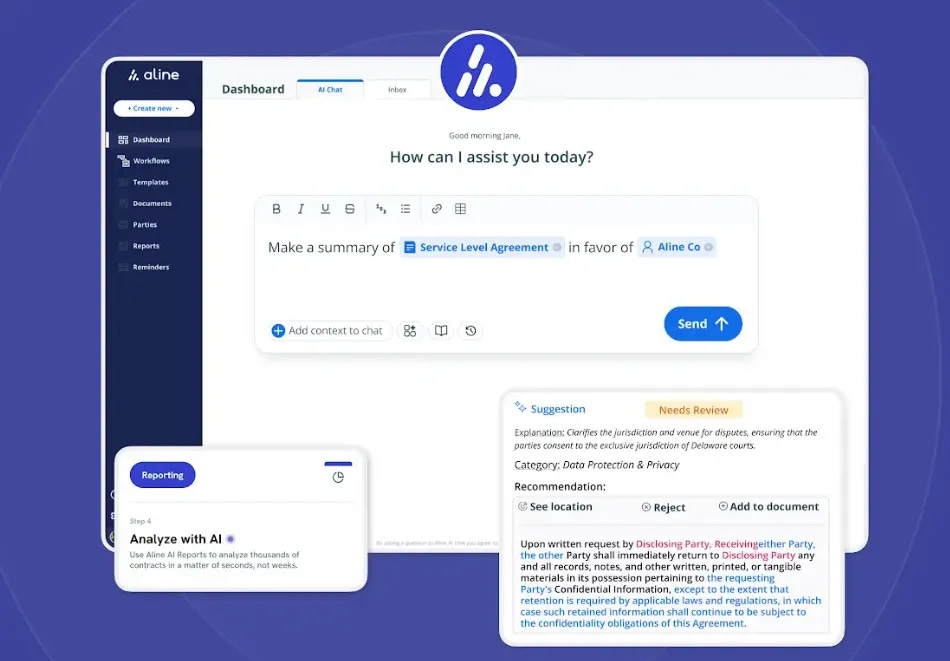
Aline syncs with local and shared drives, such as Google Drive, to analyze contracts with AI and extract any data point in plain English. Query agreements like data, with no manual tagging.
Book a demo to try Aline for free. Explore our AI contract repository and reporting, plus 25% off your first year with code George.
ORBITAL
1. Orbital Raises $60M To Take On Real Estate Law

London-based Orbital closed a $60 million Series B this week, led by Brighton Park Capital, to accelerate its expansion into the US market and build what it’s calling “a single, secure workspace for real estate legal work.” The round brings total funding to $75 million since the company’s founding in 2018.
Real estate is the world’s largest asset class, yet the legal work underpinning it hasn’t meaningfully changed for years. Orbital combines AI with spatial visualisation, mapping, and property data to automate document-heavy review across hundreds of interdependent records, maps, and historic deeds (many of which are old, scanned, and barely legible.)
I reached out to Andrew Thompson, CTO at Orbital, about what four years of pre ChatGPT work actually buys you in the current landscape.
He shared: “ChatGPT (which launched in Nov 2022) reset the natural language playing field, but it didn’t reset the domain and data problem we’ve been solving since 2018 - which in real estate legal requires reasoning over visual elements.”
Andrew walked me through why that matters. “Real estate legal is unusually messy because the ‘truth’ lives across text and visuals - title plans, maps, surveys, deed plans - often in very old scanned docs.”
Before LLMs were useful, Orbital had to get good at OCR and structuring these documents. “Not just extracting text, but preserving layout, tables, signatures, embedded images,” Thompson said. “So downstream systems can reason over them accurately. That pipeline and corpus is still a real moat.”
On what’s changed post-ChatGPT, Thompson was clear that the big unlock hasn’t been simple question-and-answer. “It’s agentic systems where an LLM is in a loop, equipped with specialised tools that it’s able to use on-the-fly to solve problems.” But the place Orbital has stayed differentiated, he said, is visual reasoning. “Current VLMs still don’t reason over boundaries and plans like a property lawyer. So we combine LLMs with more classical vision and rules/geometry approaches that we’ve built up over years and continue to heavily invest in.”
George’s take: Proprietary data is a very good moat.
The narrative around generative AI has always been that ChatGPT and its rivals levelled the playing field - that anyone could now build smart tools on top of the same foundation models. Orbital is proof that's not all true. It's the data, the pipelines, and the years spent structuring it.
VIBECODE.LAW
2. vibecode.law Launches as Legal’s First Community Coding Platform

vibecode.law went live this week as an open, community-run platform for legal professionals experimenting with AI-assisted development - what the tech world has been calling “vibe coding.” The platform was built as a weekend project by Chris Bridges, Partner at AI-native firm Tacit.legal; Alex Baker, Founder of Legal Tech Collective; and Matt Pollins, Co-Founder of Lupl. And it’s fully open source.
For years, ideas to improve legal workflows have died in informal conversations. Turning them into something tangible historically required technical teams, budgets, and formal approval, most ideas never made it any further. But AI-assisted development and low-code tools have changed that equation. Non-technical lawyers can now build simple, working prototypes themselves. vibecode.law gives those experiments a visible home.
George’s take: Collins Dictionary crowned “vibe coding” as its 2025 Word of the Year, and at the time the connection to legal felt speculative. vibecode.law makes it more concrete.
The real value here is more cultural. Legal has always been a profession where innovation happens behind closed doors, inside individual firms. It’s great to see so many lawyers and professionals actually experiment with these AI tools.
LEGORA
3. Is the per-seat pricing model broken?
On a recent appearance on the 20VC podcast, Legora CEO Max Junestrand said something most SaaS founders won’t. The pricing model is broken. Max outlined his preference to move from per-seat pricing - a fixed fee per user per month - to consumption-based pricing, where firms pay based on credits or usage.
Per-seat pricing, Max explained, is optimal for buyers, not for Legora (or any Legal AI company). Individual users can rack up significant LLM costs, and the company currently operates on what he described as “okay margins”.
He shared that consumption-based pricing would better reflect the value being delivered, but many of Legora’s clients simply don’t know how to manage usage-based models yet. “The timing is more around when the clients are ready versus when we are ready,” Max told 20VC. He predicts the shift will happen within three years, pointing to Cursor’s consumption model and the broader enterprise trend toward usage-based billing as evidence that legal will eventually follow.
George’s take: But both consumption and per-seat models fail if buyers don’t understand AI value. Under consumption pricing, firms may ration usage out of fear of racking high costs. Under per-seat, they may restrict licences to minimise spend. Either way, the outcome is the same: underutilisation. The vendors who win this transition won’t just be the ones who build the best product - they’ll be the ones who educate buyers on how to measure ROI. I think we’ll see Legal AI companies start investing heavily in value-measurement tools and dashboards over the coming months.
Bonus: California Senate Passes First US Bill Regulating Lawyers’ AI Use

First reported by Reuters, the California Senate unanimously passed SB 574 this week, making it the first US state legislature to regulate how attorneys use generative AI. The bill, now headed to the Assembly, would bar lawyers from entering nonpublic client information into public AI systems and require them to take reasonable steps to verify the accuracy of any AI-generated material before using it in legal work. Arbitrators would be barred entirely from delegating any part of their decision-making to a generative AI system.
The legislation was prompted by a string of embarrassing incidents - lawyers citing nonexistent cases generated by chatbots, AI-formatted documents submitted to courts, and confidential client data entered into public tools.
This is worth watching beyond California. If SB 574 passes the Assembly and is signed into law, other states will likely follow. I’ve already spoken about the regulatory risk back in a previous newsletter when Rishi Sunak joined Anthropic and Microsoft. The next phase of the AI race is about shaping the rules, not just building the models. For Legal AI vendors, compliance-first positioning is about to become a serious competitive differentiator.
In other AI news - Moltbot - The Open-Source AI Agent That Broke the Internet This Week

If you’ve been anywhere near tech Twitter/ X this week, you’ll have seen Moltbot. Originally called Clawdbot - and since renamed again to OpenClaw - it’s an open-source personal AI agent built by Austrian developer Peter Steinberger, founder of PSPDFKit. The project hit 60,000 GitHub stars in 72 hours and reportedly sold out Mac minis at Best Buy in San Francisco, as users rushed to set it up as a always-on AI assistant.
Rather than a chatbot that waits for your commands, Moltbot acts autonomously on your behalf. It runs locally on your machine, connects to messaging apps like WhatsApp and Telegram, and can manage calendars, send emails, browse the web, install software, and automate workflows - all without you lifting a finger. It’s completely free. You just need to bring your own API key for an underlying AI model like Claude or ChatGPT.
The hype has been extraordinary. Scientific American called it “AI with hands.” Developers on X compared it to JARVIS. One creator’s video about using it to “run my business 24/7” racked up hundreds of thousands of views. But the backlash has been just as loud. Cybersecurity researchers flagged serious risks - Moltbot requires broad permissions to function, and exposed or misconfigured instances can leak credentials, calendars, and emails. One reviewer at Platformer installed it enthusiastically, only to uninstall it days later after a string of failures. Fortune described the whole situation as “a complete mess of a computer security nightmare at scale.”
That’s everything for this week.
If you enjoyed reading this week’s roundup, consider sharing it with a friend.
I’m always looking for how to improve Best Practice. If you have any feedback, good or bad, hit reply to this email and let me know.
See you next week,
George
Solid roundup. The Orbital insight about proprietary data pipelines is key, especialy for older docs where visual reasoning still matters. I've been watching this space for a while and the firms that nailed the data ingestion early definately have a real edge now even with llms everywhere.