

Harvey Co-Founders Jump On Reddit To Defend $8B Valuation
Plus: Solve Intelligence's $40M Series B, Robin AI's Distressed Sale To Scissero

Sunday, 14th December 2025. Newsletter #13
Hey, happy Sunday.
Big news from Best Practice - I dropped my first ever podcast! I had the privilege of speaking with Alexander Kardos-Nyheim. We spoke on Alexanders’ legal AI startup and where the legal AI industry is heading.
Want to feature or know someone who’d like to be a guest? Email me at george@georgehannah.com.
Also exciting: I’ve set up subscriber referrals - you can now get rewarded for sharing Best Practice with colleagues and friends!
Let’s dig in.
Partner with Best Practice: Get your brand in front of 1,200+ legal professionals.
HARVEY AI
1. Harvey’s Co-Founders Just Wrapped Up an Ask Me Anything
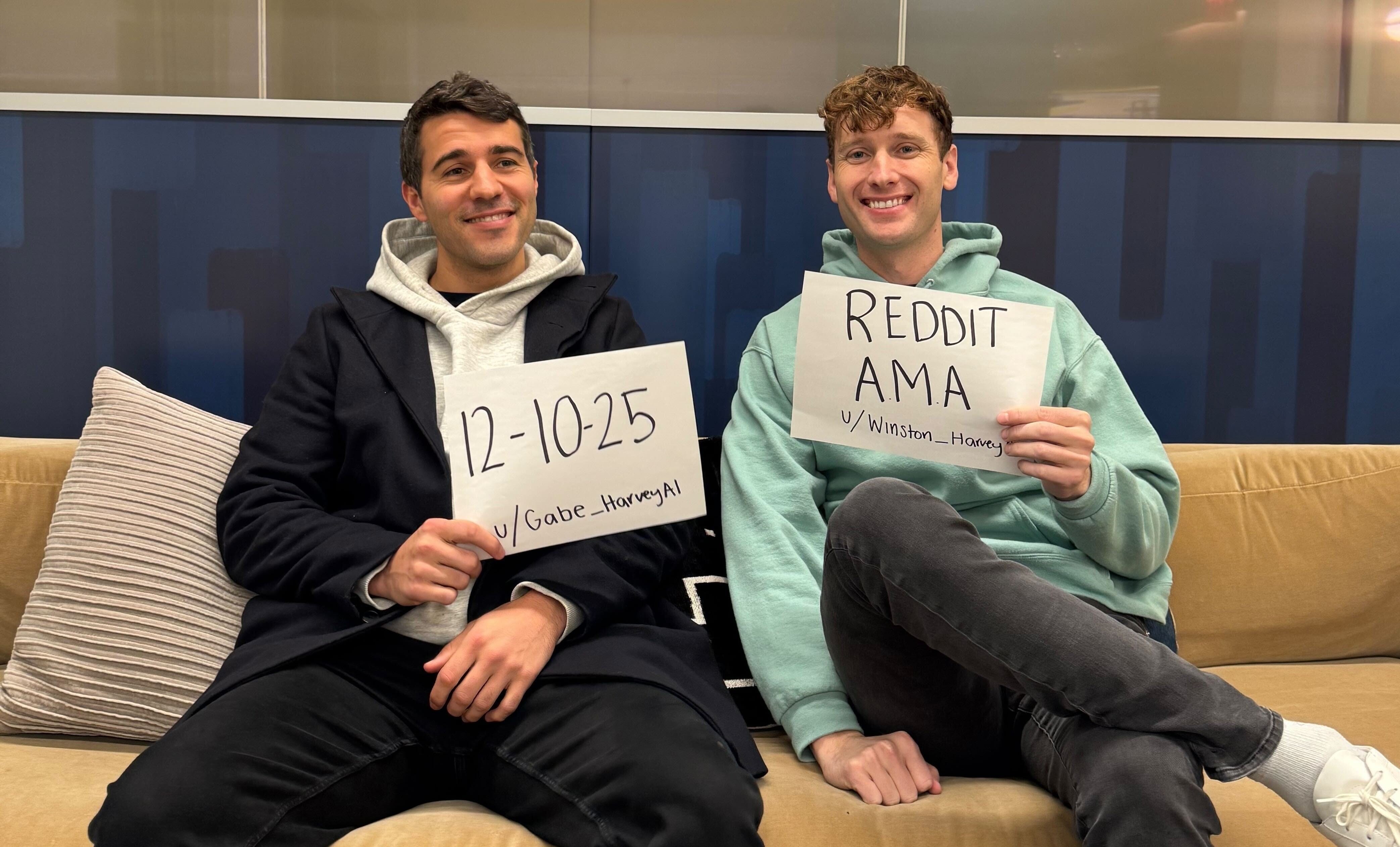
Winston Weinberg and Gabe Pereyra jumped onto r/legaltech this week for a live “Ask Me Anything,” taking questions directly from the Reddit community.
It was a great opportunity for them to clear the air. A few weeks back, an anonymous poster (claiming to work at Harvey) suggested the platform had weak engagement and only average technology. This AMA was Harvey’s chance to set the record straight.
Here are some key takeaways:
1/ On competing with Claude: Gabe’s approach is clear - Harvey isn’t aiming to outperform horizontal AI models across every domain, but instead to specialise deeply in legal work. “Better legal AI - we can make our AI better at legal because we are just focused on that compared to the horizontal providers who have to make it better at everything.”
2/ On their $8bn valuation: Winston pointed to the size and trajectory of the legal market: “There are around 10M global legal professionals, and Harvey serves just single digit percentage points of them.” With legal tech sitting around £30bn today and the wider legal IT market far larger, the suggestion is that adoption and investment in this space still have significant room to grow.
3/ On early sales to Big Law: Winston described a very direct go-to-market approach: “For litigators I would go to PACER and find the last brief they wrote and then have Harvey draft counter arguments.” Using real work to demonstrate capability proved compelling, even if it carried more risk in 2022 when hallucinations were more frequent.
George’s take: It’s good to see more founders showing up in open forums like this - it builds trust, adds a layer of authenticity, and gives users a clearer picture of what’s actually happening behind the scenes.
This follows Max Junestrand’s Reddit Q&A after Legora’s $150M Series C (which I covered in Newsletter #8).
I think we’ll see more Legal AI CEOs adopt this strategy throughout 2026. The founders who can authentically engage with skeptics in public forums will build stronger community trust and brand loyalty than those who only speak through press releases. And as the legal AI market matures, that community goodwill will matter more than funding announcements.
Enjoying Best Practice? Refer a friend and get rewarded!
NEW PODCAST
In this first episode, I ask Alexander:
How he built a successful legal AI company while managing the intense workload of a Magic Circle training contract.
The critical debate for legal tech - is the future in off-the-shelf LLMs or custom-training foundational models?
Why Big Tech’s verticalisation (like DocuGPT) is creating a market squeeze for new legal AI startups.
The potential collapse of the law firm ‘pyramid’ as AI handles the work of the £150k+ junior associate.
Plus, predictions for the legal AI landscape in 2026 and the changing risk-reward for law students.
SOLVE INTELLIGENCE
2. Solve Intelligence Just Raised $40M Series B
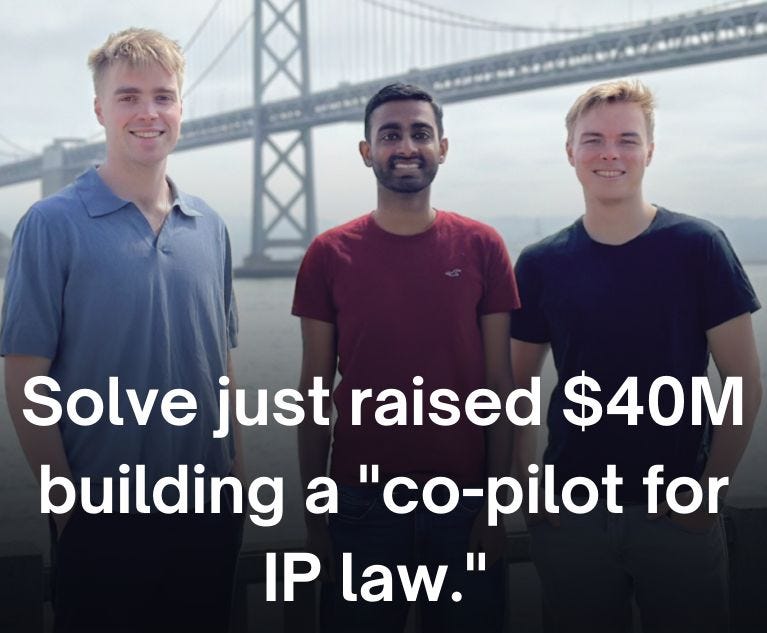
Founded in 2023 by Chris Parsonson, Angus Parsonson, and Sanj Ahilan, Solve Intelligence have already hit over 400 IP teams across six continents including DLA Piper, Perkins Coie and Siemens.
Their AI software:
Custom AI tuned just for patents and can tackle hardware setups, biological sequences and chemical formulas
Provides users with editable templates, complete with source citations
Serves both in-house teams, outside counsel, and even inventors themselves
They’ve attracted heavyweight investors including Visionaries and 20VC (leading this round), plus capital from Thomson Reuters, Y Combinator, and Operator Collective.
And angel investment from the founders of Tinder, Deel, Ironclad, Canva, Pigment and Hugging Face.
George’s take: 2026 will be the year of vertical AI specialists. I think we’ll see more startups like Solve Intelligence - not trying to be everything to everyone, but instead going deep on one practice area.
The general-purpose legal AI story is getting crowded and capital-intensive. Harvey and Legora are racing toward billion-dollar valuations by serving all of Big Law. But the real opportunity might be in building products that actually understand (for example) the nuances of patent drafting, M&A due diligence, or employment tribunal prep.
This is the same pattern we saw in vertical SaaS a decade ago. Salesforce dominated horizontal CRM, but Veeva won pharma by going deep on regulatory compliance and clinical trials. Toast beat Square in restaurants by understanding tip pooling and table management. The specialist beats the generalist when domain complexity is high enough.
ROBIN AI
3. Remember Robin AI?

Once hyped as a legal AI frontrunner, it’s now offloading parts of the business. Its managed services arm has been snapped up by Scissero just weeks after Robin was put up for sale - and notably, the actual AI product isn’t included.
This means Scissero gets an instant client upgrade (think UBS and Pfizer) and positions itself as a full-stack legal tech + managed services play. Robin, meanwhile, has had a brutal year: failed fundraising, layoffs, HMRC chasing unpaid tax, and a distressed sale process. This deal gives that team a soft landing, but it also raises the bigger question - how did one of the early legal AI names end up here?
George’s take: This feels less like a growth story and more like a cautionary tale as legal tech enters its consolidation era. Big promises are easy. Sustainable models are harder.
Robin AI positioned themselves as AI-powered contract review for enterprises. The pitch sounded compelling: reduce contract review time by 80%, spot risks instantly, free up legal teams for strategic work.
The lesson for Legal AI startups: technology alone isn’t enough. You need (1) proprietary data moats that competitors can’t replicate, (2) workflow integrations so sticky that switching costs are prohibitive, or (3) a business model that survives even if your AI advantage disappears tomorrow.
In Other AI News: Cambridge Study Finds Students Learn Better With Notes Than AI

A new study from Cambridge suggests that students who take handwritten notes learn more effectively than those who rely on AI tools to generate summaries or explanations.
However, the research also suggests that AI could support students in clarifying, exploring, and contextualising learning material - when used strategically rather than as a replacement for active engagement.
George’s take: As an apprentice simultaneously studying for my undergrad degree, this has been at the forefront of my mind.
Google Gemini and ChatGPT both offer “learn mode” features that try to address this - encouraging students to think through problems before revealing answers. But the fundamental tension remains, AI makes learning easier, but ease isn’t always better for retention.
The legal profession should pay attention here. Junior associates learning contract drafting by having an AI tool generate first drafts might complete work faster, but are they developing the same intuitive understanding of clause structure and risk identification that comes from manual drafting?
There’s a balance to strike. AI as a research assistant, drafting accelerator, or quality checker? Hugely valuable. AI as a replacement for the hard cognitive work of learning legal reasoning? Probably detrimental long-term.
That’s everything for this week.
If you enjoyed reading this week’s roundup, consider sharing it with a friend.
I’m always looking for how to improve Best Practice. If you have any feedback, good or bad, hit reply to this email and let me know.
See you next week,
George
It's interesting how Harvey's strategy is so focused on deep specialization in legal work. I'm curious how they benchmark 'better legal AI' against fine-tuned horizontal models, particularly concerning the transparency and biases inherit in legal datasets.