

Harvey Joins Claude's Ecosystem
Plus: England's first deterministic-only law firm gets SRA approval

Sunday, 1st March 2026
Hey, happy Sunday.
I’ve got some genuinely exciting podcast guests lined up that I can’t wait to tell you more about, and this week we’re debuting a slightly refreshed structure to make the newsletter a bit sharper and easier to navigate.
I’m also away on holiday this week, so the next edition of the newsletter will be delivered on Sunday 15th March.
Lets dig in.
This Week in Legal AI
Harvey gets friendly with Anthropic
Anthropic held its virtual “Enterprise Agents Day” and announced thirteen new MCP connectors for Claude Cowork, including one for Harvey.
MCP (Model Context Protocol) is Anthropic’s open standard for connecting Claude to external tools and data sources. The Harvey integration means that professionals using Claude can now invoke Harvey’s domain-specific legal capabilities directly, without switching platforms (to Havey). Speaking at Harvey’s inaugural London conference on the same day, CEO and co-founder Winston Weinberg was clear about the logic: “Enterprises generally will adopt Anthropic, so this is another access point to Harvey.” Harvey, it should be noted, is partially funded by OpenAI, making this a pointed reminder that in the foundation model wars, loyalty is a commercial calculation.
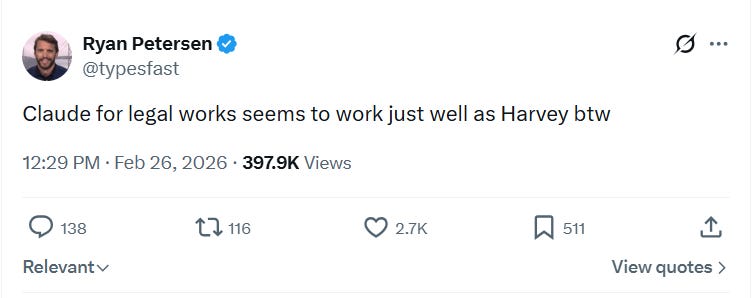
The announcement did not go without challenge. Ryan Petersen, a prominent tech entrepreneur, put the obvious question bluntly on X: "Claude for legal works seems to work just well as Harvey btw."
It is a fair observation, and one that Harvey's leadership will have anticipated. The honest answer is that Harvey's value has never been purely about model capability - it lies in years of legal-specific fine-tuning, proprietary benchmarking via BigLaw Bench, deep workflow integrations, and the trust it has built with some of the world's most demanding law firms. That is a meaningful moat, and it should not be undersold. But the MCP integration does raise a question that is genuinely difficult to answer cleanly - if Claude now connects directly to Harvey inside enterprise environments, and Claude itself is increasingly trained on legal content and capable of sophisticated legal reasoning, what exactly are users paying Harvey for that they could not, in principle, get from Claude alone? It is a confusing connector to have, not because Harvey is weak, but because Anthropic is becoming stronger across “knowledge work” territories.
Intapp also separately announced a partnership with Harvey, bringing ethical wall enforcement directly into Harvey’s platform, and launched Intapp Celeste, a purpose-built agentic AI platform that connects to both. It was, by any measure, an unusually dense week of deal-making for a single ecosystem.
Why it matters
What Anthropic is doing - and doing deliberately - is positioning their tool Claude as the connective tissue of enterprise software. The MCP architecture means that every firm, research platform, or workflow tool that plugs into Claude becomes part of an expanding ecosystem where the model is effectively the operating system.
Harvey chose integration over resistance, and its bet is that legal domain expertise, not platform access, is its durable competitive advantage. Intapp is making a similar calculation, leaning into compliance infrastructure as the moat that generic AI cannot easily replicate. LexisNexis, meanwhile, has embedded the Claude plugin into Protégé while keeping its data and infrastructure at its core. Three different postures from three different incumbents, all responding to the same structural pressure.
Worth Knowing
LawFairy becomes England’s first deterministic-only law firm - The SRA authorised LawFairy this week to operate as what it claims is the first technology-only law firm in England and Wales built on a fully deterministic legal model. Founded by former Hogan Lovells and Cleary Gottlieb partner Raj Panasar, the firm are focusing on UK immigration first, covering settlement and citizenship eligibility, including residence and absence calculations ect for ILR. It is only the second tech-driven firm to receive SRA authorisation, after Garfield.Law last year - but the first to stake everything on deterministic rather than probabilistic AI.
Thomson Reuters CoCounsel hits one million users - Thomson Reuters reported this week that one million professionals have now chosen CoCounsel across its legal, tax, risk, and compliance offerings in 107 countries. TR’s share price had dropped significantly in the wake of recent market turbulence linked to Anthropic’s legal plugin launch, but this announcement shows they are making good progress.
Best Practice Podcast
All episodes of the Best Practice podcast are available to stream on Apple Podcasts.
I have loads more podcasts in the pipeline with global leaders in Legal AI. Subscribe so that you don’t miss them.

Funding & New Partnerships
Pinsent Masons goes firmwide with Legora - Legora now counts White & Case, Linklaters, Cleary Gottlieb, and Dentons among its law firm partners, alongside tens of thousands of users across more than 50 markets.
Hotshot and Legora have partnered to deliver a structured AI training programme for law firm adoption. Hotshot, which already offers more than 350 courses for lawyers across legal, AI, and business skills topics, will develop on-demand video content and instructor-led workshops tailored to Legora’s platform. Harvey, August, and Wordsmith have all launched similar initiatives in recent months.
Mary O’Carroll - former head of legal operations at Google, and most recently COO of Goodwin Procter, has joined in-house legal AI startup Sandstone as a product expert adviser. Sandstone, which raised a $10 million seed round led by Sequoia Capital in January, is building an agentic AI platform for in-house legal departments.
Wordsmith and Cognia Law announced a strategic partnership to embed Wordsmith’s AI contract review, drafting, and analysis capabilities into Cognia’s ALSP managed legal services offering.
Know someone who might like Best Practice? Share it with them.
From the Courtroom

ByteDance found itself at the centre of a coordinated Hollywood copyright offensive this month following the launch of Seedance 2.0, its AI video generation tool. Disney sent a cease-and-desist letter on 13 February accusing ByteDance of training the model on a “pirated library” of its copyrighted characters - from Star Wars to Marvel to Family Guy - and treating protected IP as “free public domain clip art.” Paramount Skydance followed with its own letter days later, and the Motion Picture Association, representing Warner Bros. Discovery, Netflix, and others, issued a public statement demanding ByteDance “immediately cease its infringing activity.”
The tool launched on the 12 February; within days, viral videos were circulating showing Marvel superheroes, Star Wars characters, and anime figures, not as loose references, but as what Disney’s lawyers characterised as pixel-accurate replications. The Japanese government has also launched its own investigation into potential copyright violations.
The case is not yet in litigation, but it is developing quickly. It adds to a growing body of enforcement actions across the AI industry - Disney previously challenged Google and Character.AI on similar grounds - and underscores the point that output filtering, not just training data disclosure, is becoming a live legal flashpoint.
In Other AI News

Suno, the AI music generator that lets you conjure a song from a text prompt, announced this week that it has hit 2 million paid subscribers and $300 million in annual recurring revenue. To put that in context: just three months ago, when the company raised $250 million at a $2.45 billion valuation, it was reporting $200 million in annual revenue. That is a 50% jump in a quarter.
Suno has been sued by major record labels for training on copyrighted recordings without permission - a dispute that mirrors, almost exactly, the legal battles now playing out across legal AI over training data and IP rights. Yet Warner Music Group recently settled its lawsuit and struck a licensing deal instead.
Meanwhile, a 31-year-old in Mississippi used Suno to turn her poetry into a viral R&B track and signed a record deal reportedly worth $3 million. The technology clearly works well enough to produce commercially viable output, which is precisely what makes artists like Billie Eilish and Chappell Roan so uneasy about it.
That’s everything for this week. If you found this useful, consider sharing it with a colleague.
I’m always looking to improve Best Practice. Please reply to this email if there’s anything you think I should cover, change, or cut.
See you on Sunday 15th March!
George