

Harvey Just Gave Legal AI A Voice
Plus: new data shows 30% of lawyer workdays go unsubmitted, GC AI and Omnilex raise $$$, and AI-generated songs are dominating Spotify.

Sunday, 16th November 2025. Newsletter #10
Hey, happy Sunday.
This marks my 10th newsletter - a milestone I’m super excited about. When I published my first edition on 15th September 2025, I had exactly 0 subscribers. Two months later, Best Practice has grown to over 850+ legal professionals who trust me to cut through the noise in Legal AI every Sunday. Thank you for being part of this community. I’m so excited to share 2026 with you.
Anyways, another absolutely packed week in Legal AI.
Harvey partnered with ElevenLabs to give legal AI a voice - yes, literally. Laurel just dropped the most comprehensive time tracking report I’ve ever seen, revealing exactly where 3 hours of every lawyer’s day disappears. And the funding floodgates opened with $64.5 million flowing into Legal AI startups this week alone.
Let’s dig in.
Partner with Best Practice: get your brand in front of the fastest growing Legal AI newsletter. Email george@georgehannah.com
HARVEY X ELEVENLABS
1. Harvey Partners With ElevenLabs To Give Legal AI A Voice

This week Harvey announced a partnership with ElevenLabs on to bring multilingual voice capabilities to its legal AI platform. Powered by ElevenLabs’ Text-to-Speech and Speech-to-Speech technology, Harvey will be able to deliver answers audibly in almost any language, dialect, or accent.
The first phase allows Harvey to communicate naturally in dozens of languages. Future developments will introduce multilingual voice translation, voice mode, spoken trial simulations, and tone customisation.
Winston Weinberg, CEO at Harvey, said: “This partnership makes legal AI more global, accessible, and human. With ElevenLabs, we’re ensuring every lawyer can engage with Harvey in their own language and context.”
Mati Staniszewski, CEO of ElevenLabs, added: “By bringing Harvey’s legal intelligence to voice, in dozens of dialects and accents, we are helping transform how law is experienced globally.”
George’s take:
One observation here is: Do lawyers actually want to talk to their AI?
Voice mode works brilliantly for tasks where your hands are occupied - I use it whilst driving, cooking, at the gym. But legal work typically happens at a desk, with documents open, where typing is faster and more precise than speaking.
I suspect the real value here isn’t voice input (lawyers dictating to Harvey), but voice output (Harvey reading back summaries or translations). That could be genuinely useful for accessibility, for busy partners listening to research summaries while commuting, or for multilingual teams collaborating across jurisdictions.
The multilingual angle is strategically smart. Legal AI has been overwhelmingly English-language focused. Harvey expanding to dozens of languages creates defensibility in international markets where competitors haven’t invested in localisation yet.
LAUREL AI
2. New Laurel Report Reveals Where 3 Hours Of Every Lawyer’s Day Disappears
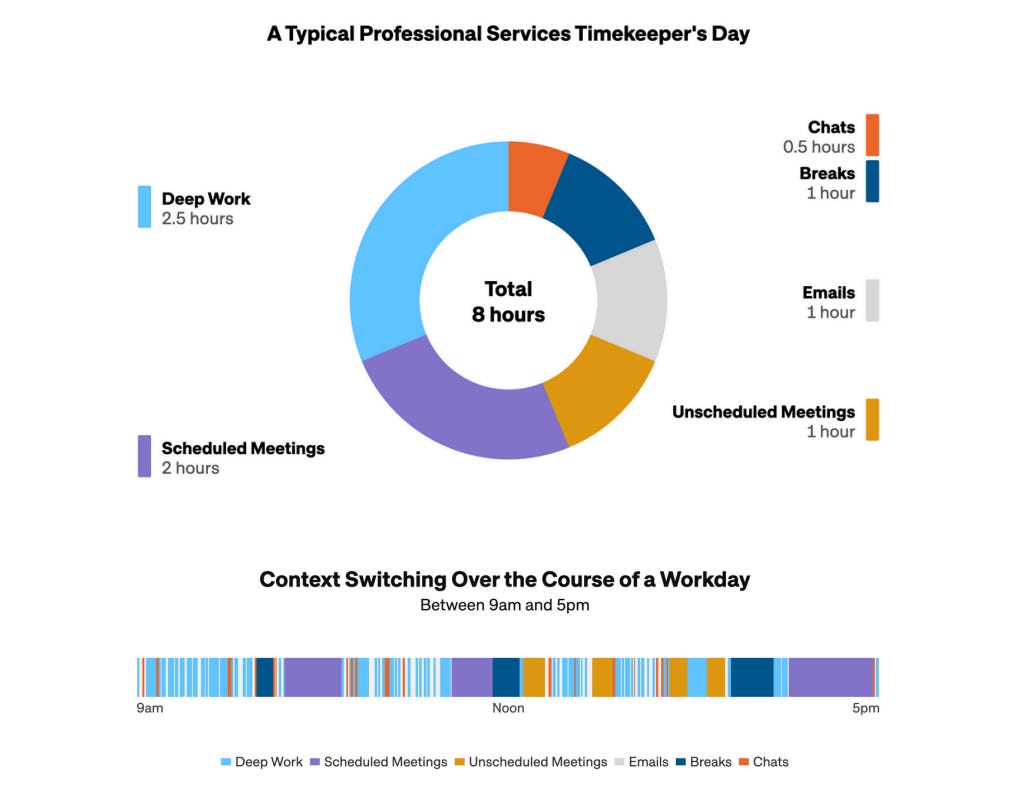
Laurel, the AI-powered time tracking platform, just released “The 2025 State of Work Report” - and it’s the most comprehensive analysis of how legal professionals actually spend their time I’ve ever seen. The report analyses work patterns from more than 2,000 professionals across legal and accounting firms.
Here are the headline findings:
The Invisible Workday: Approximately 30% of work time - around 3 hours each day -goes unsubmitted. The median professional submits 39.5 hours out of 55 hours worked. About 11% of those unsubmitted hours (roughly 20 minutes daily) represents work that should be billed. At $400 per billable hour, the report calculates that firms lose more than $26,000 annually per professional from missed billable time.
The Focus Crisis: During business hours (9am-5pm), professionals have at most 15-minute periods of uninterrupted focus before a communication requires attention. Research shows it takes 23 minutes to fully regain focus after an interruption.
The Great Displacement: 28.2% of all work occurs outside conventional business hours. Nearly half of “Deep Work” (49.5%) happens outside 9am-5pm, as professionals seek quieter periods for complex analysis.
The Meeting Problem: Meetings comprise 30.2% of all professional time (approximately 16.6 hours weekly). Most concerning: 46% of meeting time involves multitasking on email, chat, or other work - suggesting many meetings don’t merit full cognitive engagement.
George’s take: I thought it was interesting that the report shows that 30% of professional time goes to “essential but non-billable” work: training, business development, coordination, compliance.
I think coordination tasks is an easy one for AI to tackle - triaging emails, chasing people for responses, scheduling across multiple calendars, following up on outstanding items. This is the unsexy admin work that fragments a lawyer’s day but adds minimal client value. It’s also work that AI can handle reliably today.
LEGAL AI FUNDING SURGE
3. $64.5M Flows Into Legal AI As GC AI And Omnilex Close Major Rounds
GC AI Raises $60M Series B At $555 Million Valuation
GC AI announced a $60 million Series B on 12th November led by Scale Venture Partners and Northzone, with participation from Sound Ventures, Aglaé Ventures, SilverCircle Partners, News Corp, The Council, and strategic investors including Guillermo Rauch, CEO of Vercel. The round values the company at $555 million and brings total funding to $73 million.
GC AI has grown from $1 million to over $10 million ARR in under a year, averaging 23% month-over-month growth in 2025. The platform now serves more than 1,000 companies including News Corp, Nextdoor, Skims, Liquid Death, Vercel, TIME Inc., and Zscaler.
Founded by Cecilia Ziniti (three-time General Counsel at Amazon, Cruise, and Replit) and AI engineer Bardia Pourvakil, GC AI is built specifically for in-house legal teams.
Omnilex Secures $4.5M To Build AI-Generated Legal Commentary
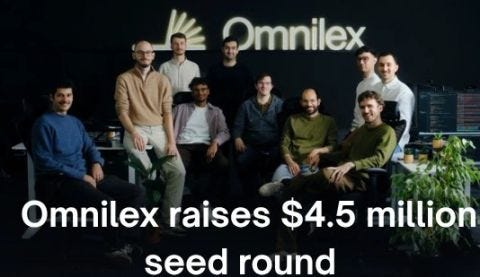
Zurich-based Omnilex announced a $4.5 million seed round on 11th November led by Founderful, with participation from Plug and Play, Tiny Supercomputer Investment Company (TSIC), and Angel Invest. The company, founded by engineers from ETH Zurich, is building what they describe as “the world’s first AI-generated legal commentary.”
Omnilex combines free public legal data - laws, court decisions, and legal precedent - with AI-generated commentary to create a comprehensive legal research platform. The company claims this approach reduces the need for paid legal databases by up to 80%, and users report saving up to 93% of research time.
Marco Henri, Co-Founder and CEO of Omnilex, told me: “Our data focused approach brings a depth to legal AI that has not been seen before. We want to bring that value to many more legal professionals. At the same time, we are continuously improving our data to become the global powerhouse of AI commentaries.”
In other AI news: AI-Generated Music Dominates Charts As Synthetic Artists Rack Up Millions Of Streams

Three AI-generated songs topped music charts this week, reaching the highest spots on both Spotify and Billboard. “Walk My Walk” by Breaking Rust - a completely AI-generated country band - has led Billboard’s “Country Digital Song Sales” chart for three consecutive weeks.
Breaking Rust has accumulated over 2 million monthly Spotify listeners despite being entirely synthetic. The “band” appeared on the internet in mid-October with no human musicians involved in music creation.
According to a new study by streaming app Deezer, 50,000 AI-generated songs are uploaded daily - representing 34% of all music submitted to platforms. The same study found that 97% of people could not distinguish between AI-generated music and human-composed music.
Billboard reported that at least one AI or AI-assisted artist has charted in each of the past four weeks, a “streak suggesting this trend is quickly accelerating.”
Spotify announced new policies to protect artists against “spam, impersonation, and deception” but stopped short of banning AI music outright, arguing that “music has always been shaped by technology.”
George’s take:
First, the quality gap is closing fast. Deezer’s study showing 97% of people can’t distinguish AI from human music mirrors what we’re seeing in legal: the Vals.ai benchmarking report showed specialist legal AI and ChatGPT performing within 4 points of each other on research tasks.
Also interesting to see how the platforms are refusing to ban it. Spotify says AI “unlocks incredible new ways for artists to create.”
That’s everything for this week.
If you enjoyed reading this week’s roundup, consider sharing it with a friend.
I’m always looking for how to improve Best Practice. If you have any feedback, good or bad, hit reply to this email and let me know.
See you next week,
George