

Harvey's CEO signals IPO plans
Plus: Inside the Vals.ai Legal Benchmarking report, a Tokyo startup hits $67M ARR faster than any US competitor, and what law firms can learn from Spotify

Sunday 19th October 2025. Newsletter #6
Good afternoon,
This week brought three significant developments in Legal AI. Vals AI published its legal research benchmarking report, revealing that specialised legal tools and ChatGPT scored within 4 points of each other - though the testing methodology has sparked debate about what these results actually measure. Harvey’s CEO Winston Weinberg confirmed the company is considering an IPO, marking a potential milestone for Legal AI as an investable sector. And LegalOn Technologies announced it has reached ¥10 billion ARR ($67M), becoming the fastest AI company founded in Japan to hit this milestone.
Let’s dig in.
Sponsored content: GrowHub

GrowHub has saved me countless hours over the past 10 months.
It transforms videos, podcasts, and articles into polished LinkedIn content in under 15 minutes, with no complex prompts needed.
Just paste your source, select a style, and you’re done.
Ideal if you’re building your personal brand but juggling a full schedule.
Try out a free trial here to see if it fits your workflow.
Want to get your brand in front of hundreds of legal professionals? Email george@georgehannah.com to find out more.
VALS AI
1. Market leaders absent from the latest Legal AI report.
Vals AI released its highly anticipated legal research benchmarking report this week, but the industry’s market leaders - Harvey, CoCounsel, vLex, and LexisNex are noticeably missing. The study evaluated Alexi, Counsel Stack, Midpage and ChatGPT across 200 US legal research questions.
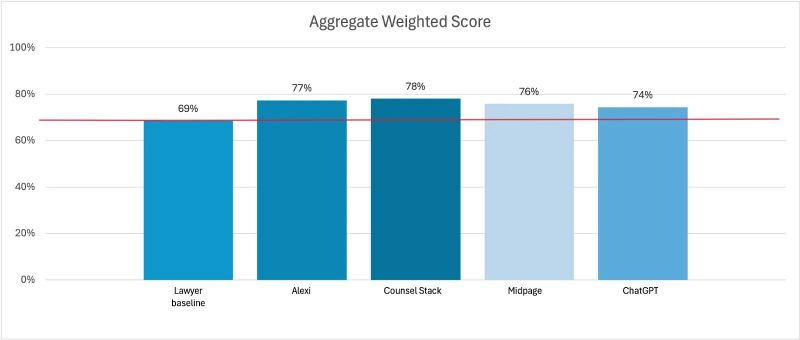
The headline finding is that legal AI and generalist AI produced highly accurate answers to legal research questions, with AI products scoring within 4 points of each other on average. Legal AI tools performed better than ChatGPT - but only marginally.
This follows VALS’ February 2025 report that tested legal AI tools on tasks like document extraction and summarisation, which included Harvey, CoCounsel, Vincent AI from vLex, and Oliver from Vecflow. Contributing law firms included Reed Smith, Fisher Phillips, McDermott Will & Emery, Ogletree Deakins, Paul Hastings and Paul Weiss.
George’s take: A professional in my comments section of my LinkedIn post pointed out something I think is worthwhile highlighting.
The absence of market leaders isn’t just a transparency problem, it’s a methodology problem.
Buried in the methodology is a critical statement: “We did not cater for follow-up prompting or addition of context, nor did we use any workflow-based features of any AI product.”
This is the entire game. Specialist legal AI products are fundamentally built on multiple prompting sequences and orchestration of complex workflows. That’s what differentiates them from generalist AI.
The methodology essentially reduced the Legal AI tools to API calls, which is exactly why the study concludes there’s only marginal difference between specialist and generalist AI.
I think this recognises that zero-shot prompt testing fundamentally misunderstands how enterprise legal AI works. Harvey’s $100M ARR isn’t from better prompts than ChatGPT. It’s from orchestration layers, security infrastructure, workflow integrations, and institutional knowledge capture that single-prompt tests will never measure.
We don’t yet have industry-standard methodologies for benchmarking legal AI the way it’s actually deployed. Until we do, treat these benchmarks as interesting data points, not purchasing decisions.
HARVEY AI
2. Harvey CEO Signals IPO Is “On The Horizon”

Reported by The Lawyer, Legal tech company Harvey has its sights set on an IPO in the future, as the start-up continues to sign up firms and corporates to use its AI-powered platform at a rapid pace.
The statement from Harvey CEO Winston Weinberg comes just months after the company’s meteoric funding trajectory: $300M Series D at $3B valuation in February 2025, followed by a $300M Series E at $5B valuation in June 2025 - just four months later. The company announced it has reached $100 million in annual recurring revenue in August 2025, just three years after launch.
Harvey plans to double its 340-person headcount with its fresh funds, with some new staff hired to help build AI products for professional services beyond legal, including tax and accounting.
George’s take: At a $5 billion valuation, this would likely be one of the largest valuations for a legal tech startup in history. For context, Clio raised at a $3 billion valuation after 17 years in business. Harvey got there in under three years.
If Harvey IPOs successfully at a $5B+ valuation, it validates a new category of legal software companies that don’t need decades of proprietary legal data to compete. Harvey uses large language models from OpenAI, Anthropic’s Claude, Mistral and Xai, combined with data and workflows designed for lawyers.
A successful Harvey IPO tells the market that AI-layer companies built on foundation models can scale faster and capture more value than traditional legal data monopolies. It’s the exact playbook that disrupted enterprise software a decade ago - Salesforce didn’t need to own all customer data to dominate CRM, they just needed the best interface layer.
I reckon we’ll see Harvey file for IPO by 2027, with a target valuation north of $7 billion. The company is growing fast enough to justify it, and an IPO would give them the public currency to start acquiring competitors and consolidating the fragmented Legal AI landscape.
LEGALON TECHNOLOGIES
3.The Tokyo Startup Silicon Valley Overlooked

LegalOn Technologies announced it has surpassed ¥10 billion in annual recurring revenue (approximately $67M), becoming the fastest AI company founded in Japan to reach this milestone.
The achievement comes just months after LegalOn’s $50 million Series E raise, bringing its total funding to $200 million. LegalOn’s platform is trusted by more than 7,000 legal teams worldwide, including over 30% of Japan’s public companies and 87% of its Fortune 500 firms.
Recent strategic collaborations include partnerships with OpenAI, with LegalOn implementing a strategic alliance in July 2025 to develop products utilising cutting-edge AI. The company has also expanded internationally, opening offices in the US and UK, with overseas sales growing 4x year-on-year in 2024.
George’s take: I think we often look towards Silicon Valley for the “next big thing,” often missing category defining companies building quietly in other markets.
LegalOn was founded in Tokyo in 2017 by two corporate lawyers frustrated by the inefficiencies and risks of manual contract review. By the time generative AI became mainstream in 2022, LegalOn was already at the forefront of legal AI innovation, releasing advanced features like AI contract editing and redlining.
LegalOn hit $67M ARR before most US and European Legal AI companies even launched their products. While Harvey and Spellbook were founding in 2022, LegalOn had already spent three years building enterprise-ready legal AI and had thousands of paying customers already.
I reckon we’ll see LegalOn aggressively expand in the US market throughout 2026, leveraging their OpenAI partnership and proven product-market fit in Japan to win over American law firms. The narrative shift from “Japanese legal AI company” to “global legal AI leader” is already happening, and US firms that aren’t evaluating LegalOn alongside Harvey and Legora are missing a serious competitor.
In other AI news: Spotify Partners With Major Labels to Build “Artist-First” AI Music

Spotify announced plans to collaborate with Sony Music Group, Universal Music Group, Warner Music Group, Merlin, and Believe to develop responsible AI products that empower artists and songwriters.
The company emphasised that “some voices in the tech industry believe copyright should be abolished. We don’t. Musicians’ rights matter. Copyright is essential. If the music industry doesn’t lead in this moment, AI-powered innovation will happen elsewhere, without rights, consent, or compensation.”
Spotify has begun building a generative AI research lab and product team, with work already started on the first products. The collaboration will focus on four key principles: partnerships with record labels and distributors through upfront agreements, allowing artists to choose if and how to participate, creating new revenue streams with fair compensation, and ensuring AI tools deepen artist-fan connections rather than replace human artistry.
The announcement comes less than a month after Spotify revealed it removed over 75 million “spammy tracks” over the past 12 months and rolled out new policies to protect artists from AI impersonation and deception.
George’s take: This is the template for how every industry should approach gen AI and Legal should be watching closely.
Spotify got three historically competitive major labels to agree on a framework for AI development before building the products. That’s the opposite of how most tech companies operate, where they build first and ask for forgiveness (or licensing) later.
The parallels to Legal AI are striking. Replace “artists and songwriters” with “lawyers and law firms,” and you have exactly the conversation happening in legal right now; “Who owns the training data? How do you compensate the people whose work powers the AI? How do you build tools that augment rather than replace professionals?”
That’s everything for this week.
If you enjoyed reading this week’s roundup, consider sharing it with a friend.
I’m always looking for the latest on Legal AI. Send me a message if you’ve seen something I can cover, or just want to say hi!
See you next week,
George
Wow, the part about Harvey considering an IPO really stood out to me, trully validating your earlier predictions about AI becoming a serious investable sector.