

Heated Reddit Debate Puts Legal AI Vendors in the Spotlight
And Wexler AI Raises $5.3M for Real-Time Litigation Fact-Checking, and Linklaters rolls out Legora firm-wide.

Sunday, 28th September 2025. Newsletter #3
Good afternoon,
At the time of writing (12:45pm UK time) we are up to 74 subscribers to Best Practice! I’m so happy that so many of you are keen to learn how AI is shaping of the legal industry. For those that are new, take a look at the mission for Best Practice.
First up:
WEXLER AI
1. Wexler AI Secures $5.3M Seed Round for Litigation Innovation

Firstly, who are Wexler AI?
Wexler AI is a London-based legal technology startup founded in 2023 by Gregory Mostyn and Kush Madlani, specialising in advanced AI tools for litigation teams.
This week, Wexler AI announced they raised $5.3M in a seed round led by Pear VC and joined by Seedcamp and The LegalTech Fund, targeting advanced AI for litigation workflows. Their platform promises real time fact checking, which can flag inconsistent witness testimony live - a capability already trialed by major firms like Clifford Chance and Addleshaw Goddard. The deal is validation of specialised vertical tools, with Wexler growing 20x in ARR while slashing manual review time.
George’s take: I think there’s becoming a the ascendance of purpose-built, “scalpel” AI over more general purpose “Swiss Army knife” platforms. The market is maturing, and the future of AI in Big Law will be dominated by tools that deeply integrate into specific practice areas to drive unprecedented efficiency and tactical advantage.
HARVEY AI
2. Harvey AI Reddit Controversy Shows Legal AI Is Growing Up
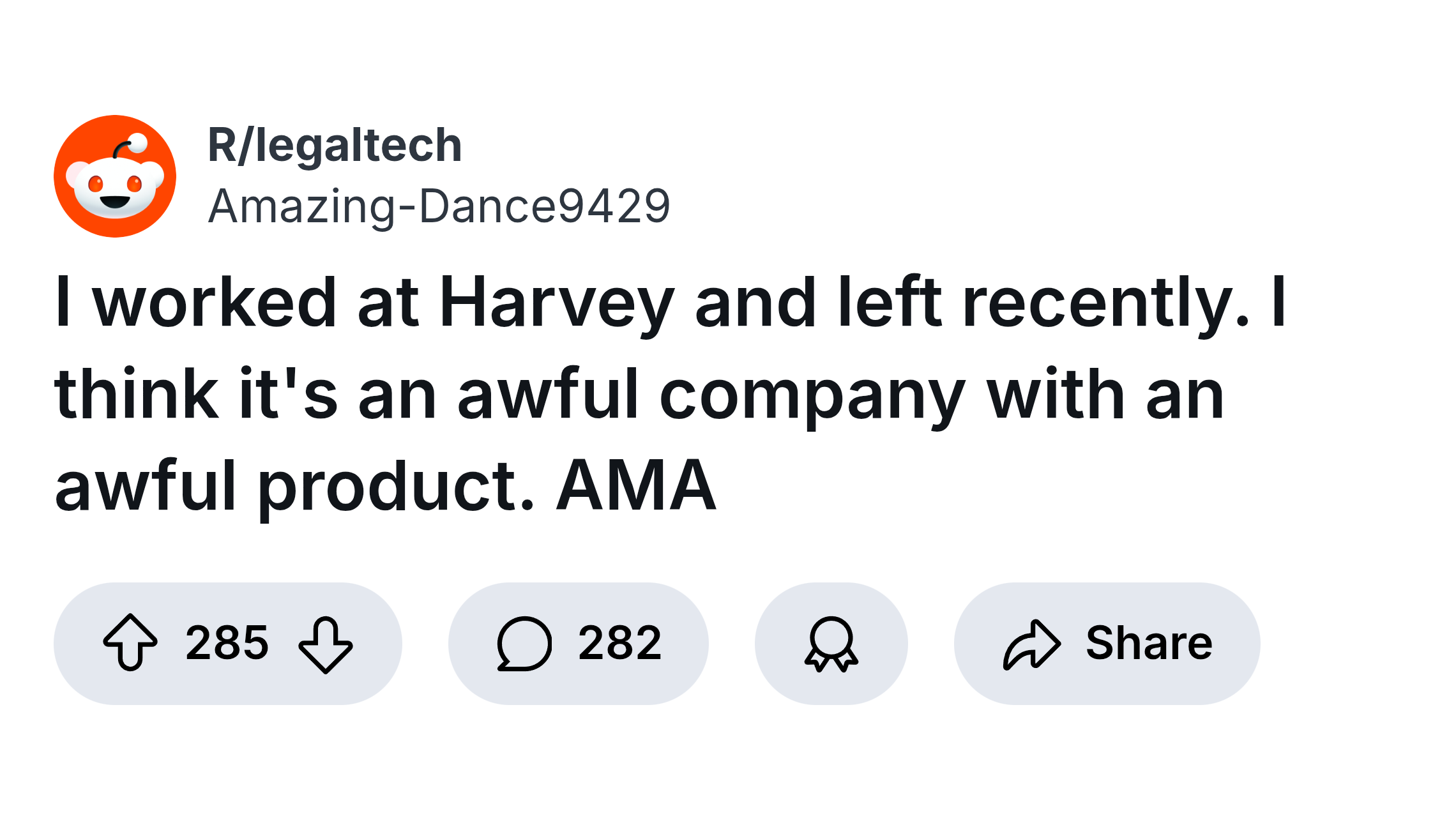
Harvey AI found itself at the center of a heated Reddit debate this week when user ‘Amazing-Dance9429’ launched a scathing attack on the entire legal AI industry, questioning the value for thousands of employees and tens of thousands of lawyers using these platforms.
Here’s why the key criticisms miss the mark:
“Only lawyers can build successful legal tech”
This fundamentally misunderstands how effective technology gets built. Legal knowledge can be hired in, and domain expertise develops through user feedback -not initial pedigree. Many successful legal tech tools weren’t designed by lawyers at all.
“Foundation model startups don’t create value”
Raw ChatGPT isn’t a functioning legal solution. Enterprise-ready legal AI requires secure certifications, integrations with iManage/NetDocs/LexisNexis, intuitive UI, firm-specific customisation, and orchestrated deployment of multiple models.
Almost no law firms want to build and maintain their own AI infrastructure - that’s exactly why specialised vendors exist.
“No one actually uses these tools”
Legal AI has been adopted faster than any prior technology in the industry. Platforms like Harvey and Legora have scaled across major firms at record speed.
Harvey co-founder Winston Weinburg responded by sharing concrete usage metrics and revenue retention data, demonstrating robust engagement across their client base.
See more on my LinkedIn post. The Reddit post has since been deleted, but you can still read the thread here.
George’s take: As someone working at a law firm that uses Harvey day to day, I see both sides of this Reddit storm. The tech is powerful, no question, but the debate highlights a truth young lawyers feel keenly. AI in law isn’t judged on promise anymore, it’s judged on proof; and if tools like Harvey don’t seamlessly embed into workflows and show measurable impact, the hype won’t carry them.
LEGORA X LINKLATERS
3. Linklaters Delivers a Firm-Wide Win for Legora’s AI Platform

Linklaters rolled out Legora’s GenAI platform firm wide following a successful pilot, integrating the solution across 30 offices and embedding it in practice group workflows. Legora’s $80M Series B and rapid 400+ client growth set the stage for this enterprise-level adoption, further extending Linklaters’ AI toolkit alongside Laila, ReportIQ, and CreateiQ 2.0.
George’s Take: Linklaters’ Legora announcement feels oddly late to the party, when other firms have been using the platform for over a year. But that’s precisely the point. We’ve moved from “who has AI?” to “everyone has AI.” The legal AI playing field is levelling fast. By the end of 2025, almost every top-tier firm will have these tools embedded, making AI the new baseline rather than a differentiator. This sets up 2026’s critical question: if every firm has the same AI horsepower, what will truly set them apart? These firms will need to reinvent client service with AI-powered dashboards and real-time insights, build cultures where AI literacy is as basic as email, experiment with radical new business models, and turn AI governance into competitive advantage.
In other news:

The UK government has reported a major success in its anti-fraud efforts, announcing that a new AI system, the Fraud Risk Assessment Accelerator, helped government teams recover a record £480 million in the year to April 2025, with £186 million specifically clawed back from pandemic-related fraud schemes. This cutting-edge tool, which is designed to proactively scan and “fraud-proof” new policies, is now set to be licensed for international use by allies including the US, Canada, Australia, and New Zealand (how cool is that?!) While the government plans to use the recovered funds to hire nurses, teachers, and police officers, the move is being met with continued scrutiny from civil liberties groups concerned about the ethical implications and potential for bias in the government’s expanding use of AI technologies.
That’s everything for this week.
If you enjoyed reading this weeks roundup, consider sharing it with a friend.
I’m always looking for how to improve Best Practice. If you have any feedback, good or bad, hit reply to this email and let me know.
See you next week,
George