

How Linklaters' 20-Person AI Team Could Force Every Magic Circle Firm to Follow
Plus: White & Case builds Atlas, its own AI assistant; Warner Music settles Suno lawsuit, partners on licensed AI music

Sunday, 30th November 2025. Newsletter #11
Hey, happy Sunday.
We’ve hit quadruple digits! Newsletter #11 marks a milestone for Best Practice for having over 1000 subscribers, and I’m grateful to each of you for being part of this journey.
This week, we’re seeing law firms take dramatically different approaches to AI implementation. Linklaters created an entirely new role - the “AI Lawyer” - while White & Case has built its own proprietary platform from scratch.
Let’s dig in.
Partner with Best Practice to get your brand in front of 1000+ legal professionals. Email george@georgehannah.com
LINKLATERS
Linklaters Launches 20-Strong “AI Lawyer” Team
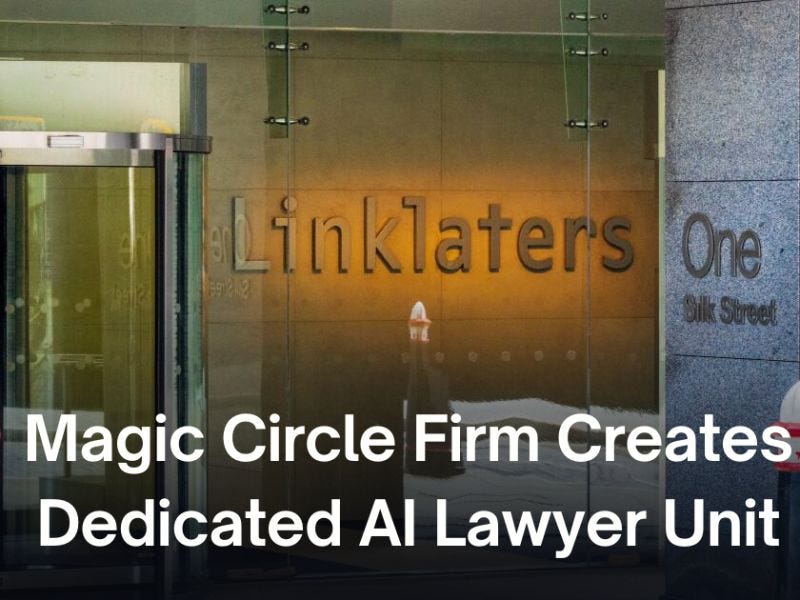
Linklaters announced this week the launch of a 20-person global team of specialist “AI Lawyers” - a new hybrid role that blends legal expertise with hands-on AI implementation. The team comprises both external hires from tech backgrounds and experienced Linklaters lawyers who have retooled their legal expertise with dedicated AI training.
The AI Lawyers will undergo an intensive internal “bootcamp” covering Linklaters’ AI strategy, power-user features of the firm’s tools, prompt engineering and workflow design. Following training, they’ll be embedded directly into practice groups and offices globally, working alongside client-facing lawyers to develop prompts, workflows, and AI-enabled solutions.
Sarah Barnard, Linklaters’ Director of AI Delivery, explained the strategic thinking: “We’ve identified these 20 individuals across different practices and multiple jurisdictions, and we’ve said, ‘We are embedding you back into the practice group initially that you come from, but your full-time job, your dedicated role is making sure that we have identified the use cases and implemented them into the processes that already exist to reduce friction as much as possible.’”
George’s take:
What’s particularly clever is the embedding strategy. These aren’t innovation team members sitting in a separate department. They’re lawyers who maintain credibility within their original practice groups while focusing entirely on AI integration. That solves the classic innovation problem: external consultants lack context, but busy fee-earners lack bandwidth.
I reckon within 24 months, the “AI Lawyer” role becomes standard across top-tier firms - just as knowledge lawyers and legal project managers did before them. The question isn’t whether firms will adopt this model, but whether they’re building the internal capabilities now or waiting until their competitors force their hand.
WHITE & CASE
White & Case Builds Atlas - Its Own AI Assistant

White & Case launched Atlas this month, a conversational AI assistant built on the firm’s proprietary AI platform - marking a decisive shift toward firms building their own AI infrastructure rather than solely relying on third-party vendors.
Atlas is a ChatGPT-style application developed in partnership with Deloitte that can use multiple AI models and includes web search, chat history, a prompt library, and document upload capabilities across different formats. Lawyers can create custom prompts and share them globally - meaning if M&A lawyers in APAC develop prompts that work particularly well, those can be reused across the firm to drive global consistency.
Chief Innovation Officer Isabel Parker, who joined White & Case from Deloitte in October 2024, described Atlas’s development as iterative. The first rollout happened in mid-October, with the team continuing to build and improve features “to keep the energy and engagement.” The December or early January release will bring deep research capabilities, allowing Atlas to search curated datasets like precedent databases and knowledge banks.
George’s take: This is the classic build-versus-buy decision, and White & Case has chosen “both.” By developing Atlas on their own platform while also adopting third-party tools , they’re creating optionality. If vendor tools meet their needs, great. If not, they can build custom applications that integrate with their existing stack.
The economics of this approach are worth examining. Building and maintaining a proprietary AI platform requires significant ongoing investment - engineering talent, infrastructure costs, and continuous model training. But it also means White & Case controls the roadmap, data governance, and integration pathways in ways that pure vendor relationships don’t allow.
I think we’re seeing the emergence of a two-tier strategy across BigLaw. Tier one firms with significant resources will pursue hybrid approaches like White & Case - buying best-in-class vendor tools while building proprietary platforms for firm-specific needs. Tier two and smaller firms will rely primarily on vendor solutions, accepting some loss of differentiation in exchange for lower upfront investment.
WARNER MUSIC GROUP
In other AI news: Warner Music Settles Suno Lawsuit, Partners on Licensed AI Music

Warner Music Group (WMG) announced on 25th November a landmark settlement with AI music generator Suno, ending their copyright lawsuit and launching what they’re calling a “first-of-its-kind” licensing partnership for AI-generated music.
The deal settles WMG’s $500 million copyright infringement lawsuit filed in summer 2024 alongside Universal Music Group and Sony Music (those lawsuits remain ongoing). Under the partnership, Suno will launch new, more advanced licensed AI models in 2026 that will replace its current unlicensed models. Artists and songwriters will have full control over whether and how their names, images, likenesses, voices, and compositions are used in new AI-generated music.
George’s take: Replace “songs” with “legal documents” and “artists” with “law firms,” and you have exactly the dynamic playing out in legal. LegalOn, Harvey, Legora, and others are building models trained on massive corpuses of legal work. Unlike music, most legal documents aren’t individually copyrighted in the same way, but firms absolutely view their precedents, know-how, and work product as proprietary assets.
Maybe we will see similar partnerships emerge in legal within 18 months. Could a major law firm announce a licensing deal with a Legal AI platform, granting access to curated precedents and know-how in exchange for revenue sharing and control over how that institutional knowledge gets deployed?
That’s everything for this week.
If you enjoyed reading this week’s roundup, consider sharing it with a friend.
PS. Looking ahead to 2026, I’d love to hear what you want to see more of in Best Practice. It’s just one question!
See you next week,
George