

Legora's Billion-Dollar Bets
Plus Lewis Silkin's new AI agent, and AI That Finally Remembers.

Sunday, 5th October 2025. Newsletter #4
Good morning,
This week, we’re seeing massive capital flowing into Legal AI, firms building their own specialised tools, and a fundamental shift in how AI remembers your work. Let’s dive in.
Sponsored content: GrowHub

I’ve been using GrowHub for 10 months now.
GrowHub turns any YouTube video, podcast, or article into ready-to-publish content in under 15 minutes.
Simply paste a URL, choose your writing style, and generate professional posts without the prompt engineering headache.
Perfect for busy professionals, like me, who want to build thought leadership on LinkedIn without the time investment.
Try out a free trial here.
LEGORA
1. Legora’s Billion-Dollar Momentum

Swedish legal AI startup Legora is in discussions to raise over $100 million at a $1.7 billion valuation, just five months after closing an $80 million Series B round. The platform is now used by lawyers across 250 firms in 20 markets globally, including Cleary Gottlieb, Bird & Bird, and Goodwin.
Legora’s platform helps legal teams reduce contract review times by up to 80% and cut due diligence costs by more than half. The company offers features like Tabular Review (transforming folders of contracts into interactive grids), Word integration for drafting and markup, and comprehensive legal research capabilities.
George’s take: The speed of Legora’s valuation growth signals that investors see Legal AI adoption accelerating faster than anticipated. The company reached Series B in under two years since inception, demonstrating that law firms are moving beyond pilots to firm-wide deployments. It also shows us how the “boring” legal work is where the real money is. Document review, contract drafting, research - these aren’t sexy tasks but they’re exactly where lawyers spend 60% of their billable hours. Legora’s revenue jumped from $4M to $23M by automating the mundane. Every repetitive legal task is now a billion-dollar wedge if you build the right AI.
2. Lewis Silkin Launches Delphius for Global Employment Law
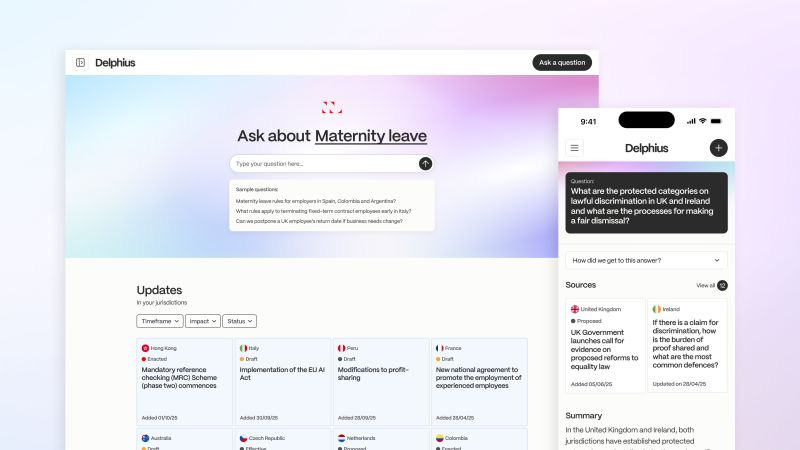
UK law firm Lewis Silkin, in partnership with Ius Laboris, launched Delphius, an AI-powered platform for global employment law knowledge, aimed at in-house legal and HR teams that covers more than 50 jurisdictions.
The platform provides instant access to employment law knowledge and upcoming legal changes, with regular updates from local experts. Users can ask follow-up questions to drill down into details and easily connect to specialist lawyers when additional support is needed.
Richard Miskella, Joint Managing Partner at Lewis Silkin, explained the platform was developed directly from client conversations, with many asking for faster, smarter access to reliable international legal knowledge.
George’s take: This represents a strategic shift where law firms are building and owning their own AI tools rather than solely relying on third-party vendors. By creating Delphius, Lewis Silkin transforms their existing institutional knowledge into a scalable product that serves clients between engagements, creating stickiness and new revenue streams. I’m pretty interested in the business model of this. For in-house counsel, this changes the engagement model: you can get instant guidance on routine matters and reserve billable hours for complex strategy. For law firms, identify your most frequently asked client questions, capture that knowledge, and consider building an AI layer that delivers it efficiently.
AUGUST AI
3. August Introduces Personas. AI That Actually Remembers How You Work

Legal AI startup August launched Personas, described as a memory layer purpose-built for legal work that remembers how lawyers specify formats, style preferences, and recurring facts, then applies those details where needed.
In internal testing with more than one hundred lawyers, Personas improved output accuracy by more than 25% on average and cut follow-up questions by more than twofold. Early users found that Personas helped retain and share institutional knowledge, from a partner’s memo structure to a client’s standing instructions, so teams moved faster with fewer repetitive prompts and handoffs.
To protect client confidentiality, Personas encrypts data, enforces hard client- and matter-level walls, and limits access by role with approvals, with options for data residency and enterprise key management.
George’s take: This tackles one of Legal AI’s biggest practical problems: every interaction requires you to re-explain your preferences, your firm’s style guides, and client-specific requirements. Tools without sophisticated memory will require constant re-prompting, killing the productivity gains they promise. More importantly, start documenting your firm’s institutional knowledge now, partner preferences, client guidelines, drafting conventions. These will become the training data for your firm’s AI memory systems. I think this will be the one of the highlight features for Legal AI in 2026, especially with perhaps an iManage or NetDocs integration with Legora / Harvey.
In other AI news: FIFA’s 2026 World Cup Ball Puts AI on the Pitch

FIFA unveiled the official match ball for the 2026 World Cup on Friday - and it’s equipped with AI technology that could change how the game is officiated. The “Trionda” ball (named for the three host nations: United States, Canada, and Mexico) features an embedded AI chip that sends real-time data to the Video Assistant Referee (VAR) system.
Designed by Adidas, the connected ball technology enables faster offside and handball decisions by transmitting live data on ball position, movement, and individual touches. Combined with player position tracking, the system aims to reduce decision-making time and improve accuracy during matches. The technology also accounts for varying weather conditions across the host nations, with surface design elements that increase grip in damp conditions.
The 2026 tournament kicks off June 11 at Mexico City’s Estadio Azteca and concludes July 19 in East Rutherford, New Jersey.
That’s everything for this week.
If you enjoyed reading this weeks roundup, consider sharing it with a friend.
I’m always looking for how to improve Best Practice. If you have any feedback, good or bad, hit reply to this email and let me know.
See you next week,
George