

Legora’s CEO Hits Reddit To Answer The Hard Questions
Plus: Ropes & Gray Makes AI Experimentation Billable, And DeepJudge Raises $41M To Wire AI Into Firm Knowledge Systems

Sunday, 9th November 2025. Newsletter #8
Hey, happy Sunday.
This week DeepJudge raised $41 million to wire AI into firm knowledge systems, Legora launched Portal to own the entire collaboration stack, and Ropes & Gray made AI experimentation billable. Oh, and Legora’s co-founder Max Junestrand jumped on Reddit to answer the hard questions about where his company is headed.
Let’s dig in.
Partner with Best Practice get your brand in front of 750+ of legal professionals. Email george@georgehannah.com
ROPES & GRAY
1. Ropes & Gray Makes AI Experimentation Billable

Ropes & Gray, a 1,500-lawyer international firm, announced that new associates can now allocate up to 20% of their required billable hours toward AI training and experimentation, as reported by Reuters.
With the firm’s first-year billable target generally set at 1,900 hours, this means associates can spend approximately 380 hours annually exploring AI tools, running simulations, and developing AI literacy - all counting toward their billable requirements.
A firm spokesperson confirmed that first-year associates “consistently meet” the 1,900-hour target, suggesting this isn’t a reduction in expectations but rather a reallocation of what counts as billable work. The policy applies to both structured AI training programs and unstructured experimentation, including individual and group learning sessions.
George’s take: Under the old model, associates who spent time learning AI tools were falling behind on their billable hours. Every hour spent experimenting with AI tools was an hour not spent on client work. So even when firms wanted associates to use AI, the billable hour incentive structure discouraged it.
By allowing 380 hours of AI experimentation per associate, Ropes & Gray is betting that the productivity gains from AI-fluent lawyers will more than offset the “lost” billable hours. If an associate spends 380 hours mastering AI tools and becomes 30% more efficient in their remaining 1,520 hours, the firm comes out ahead. And the associate develops skills that make them more valuable in an AI-saturated legal market.
LEGORA
2. Legora’s CEO Takes Questions on Reddit
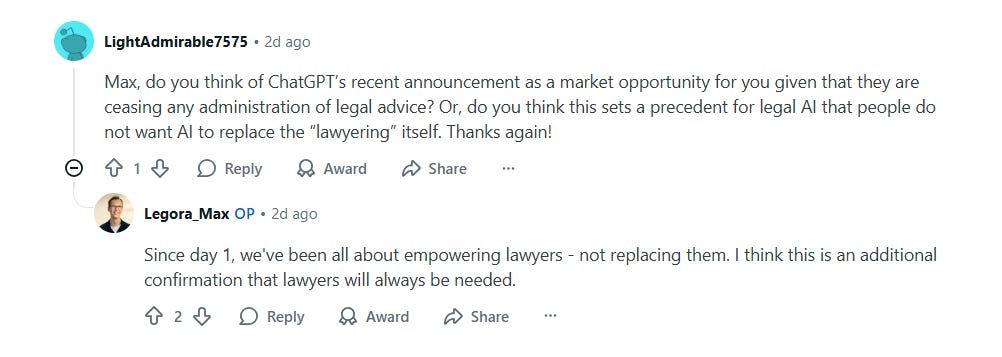
Days after announcing Legora’s $150 million Series C, CEO Max Junestrand did something unusual for a freshly minted near-unicorn founder. He logged onto Reddit and answered tough questions from skeptics, competitors, and curious users.
The Reddit Q&A, posted two days ago, came on the heels of Legora’s Precedent summit in New York and the Portal announcement.
Key exchanges from the Q&A:
On Portal strategy and DMS concerns: Addressing questions about how Portal would differentiate from existing tools like Microsoft SharePoint, Max clarified Legora’s positioning: “We are not trying to be a DMS. Legora (and the portal) will integrate with both iManage and Sharepoint. The portal will serve as a collaborative workspace between the law firm and their clients, so that they can work more seamlessly together.”
On differentiation from ChatGPT: When challenged about what makes Legora unique compared to general-purpose AI, Max outlined Legora’s core features: Assistant, Tabular Review, Word Add-in, Workflows, and Portals - ”with Enterprise functionality and supporting integrations with legal-specific document management systems, legal data providers, and CLMs.”
He detailed practical applications: “Extract data from +10,000s documents, Create workflows that redline contracts according to firm-specific playbooks, Draft contracts while keeping formatting in Word, Leverage precedent and internal knowledge basis as context.” His conclusion: “There is for sure some overlap with all ‘general purpose’ AI tools, but also a lot that makes us unique!”
On concerns about the AI bubble: When asked about pushback from corporations regarding law firms passing tool costs to clients, Max acknowledged the complexity: “AFAIK most law firms are not passing on the costs of the tools to the clients - but even if they were, I think clients (in-house teams) will always look to get the best service and value. Tech will be a part of that, and they’ll increasingly go to legal service providers who are leveraging tech in a sensible way.”
On AI bubble concerns and competitive positioning: Max addressed skepticism about rapid growth: “I like to think that Legora has been able to grow so quickly because we are generating massive value for a lot of clients. This value and the high-usage we’re seeing combined with our clients wishes for us to build them more things makes me feel comfortable in our position even if we live in an ‘AI bubble’.”
George’s take: While Harvey faced Reddit backlash in September that forced Winston Weinberg to defend the company with usage metrics and retention data, Max chose to preemptively engage on his own terms - right after a major funding announcement when confidence is high.
My prediction: we’ll see more Legal AI CEOs adopt this strategy. Founders who can authentically engage with skeptics in public forums will build stronger community trust and brand loyalty than those who only speak through press releases.
DEEPJUDGE
3. DeepJudge Raises $41.2M to Build Legal AI’s Infrastructure Layer
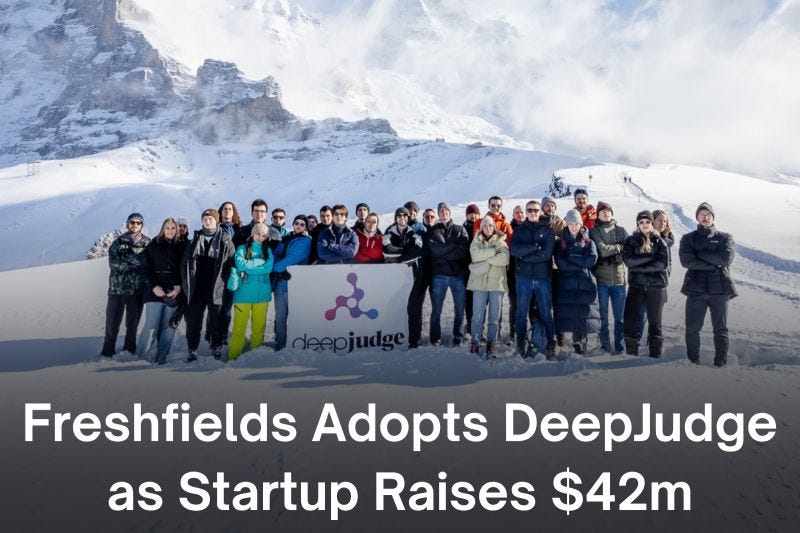
DeepJudge, the Zurich-based Legal AI startup, closed a $41.2 million Series A round this week and announced Freshfields as a flagship customer. The company, founded by ETH Zurich AI researchers Paulina Grnarova, Tobias Holstein, and Florian Kerschbaum, is building what they describe as “the infrastructure layer” for Legal AI -connecting every knowledge system inside a law firm without moving documents.
Unlike chat-based Legal AI tools that sit on top of existing systems, DeepJudge integrates directly with document management systems, intranets, emails, and client portals, creating what the company calls a “unified knowledge graph” across permission-walled data. The platform is designed specifically to handle the messy, secure, context-rich information that causes generic RAG (Retrieval-Augmented Generation) models to break down.
George’s take: DeepJudge is betting that the real value is what lawyers don’t see, the infrastructure that connects siloed knowledge systems.
Think about the actual workflow problem: A partner needs precedent on a specific clause structure. That information might live across iManage, the firm intranet, old emails, and a SharePoint site from a transaction three years ago. Current Legal AI tools can only search what they can access, which means lawyers still manually hunt across systems. DeepJudge promises to eliminate that fragmentation entirely.
In other AI news: “Vibe Coding” Named Collins Dictionary’s Word of the Year

Collins Dictionary crowned “vibe coding” as its 2025 Word of the Year - the practice of creating apps and websites by describing them to AI rather than writing code manually.
The term was coined in February by OpenAI co-founder Andrej Karpathy to describe how AI lets programmers “forget that the code even exists” and “give in to the vibes” while building software. By simply telling an AI tool “make me a program that schedules my weekly meals,” non-coders can now build basic applications without any programming knowledge.
More complex tools still require technical skill, and the practice isn’t perfect - there’s no guarantee the code will work or be bug-free. But it has democratised software creation in a way that mirrors what we’re seeing in legal AI - specialised expertise becoming accessible to non-experts through natural language interfaces.
Other notable entries on Collins’ 2025 shortlist included “clanker” (frustration with AI-powered machines, viral on TikTok), “broligarchy” (tech CEOs’ political influence), and “aura farming” (doing things for the sake of looking cool on camera).
That’s everything for this week.
If you enjoyed reading this week’s roundup, consider sharing it with a friend.
I’m always looking for how to improve Best Practice. If you have any feedback, good or bad, hit reply to this email and let me know.
See you next week,
George
Hi George! I’m Harshith. I write on VC and Startups in the LegalTech sector. My latest post breaks down the biggest M&A transaction we’ve seen in the LegalTech space. I though it could be of interest to you.
https://harshithviswanath.substack.com/p/breakdown-of-clios-acquisition-of