

Magic Circle Cuts 50 Jobs As AI Reshapes Legal Work
Plus: Harvey Crosses The Atlantic and Norm AI Raises $50M From Blackstone

Sunday, 23th November 2025. Newsletter #11
Good morning,
Harvey just crossed the Atlantic, partnering with Oxford, King’s College London, and two other leading UK law schools to embed AI into legal education. Meanwhile, Clifford Chance is cutting 50 London roles, and PwC’s global chairman told the BBC that fewer entry-level graduates will be hired as AI reshapes professional services. And Norm AI just raised $50 million from Blackstone while launching an AI-native law firm.
Let’s dig in.
Partner with Best Practice: get your brand in front of the fastest growing Legal AI newsletter. Email george@georgehannah.com
HARVEY AI
1. Harvey Expands Law School Program to the UK
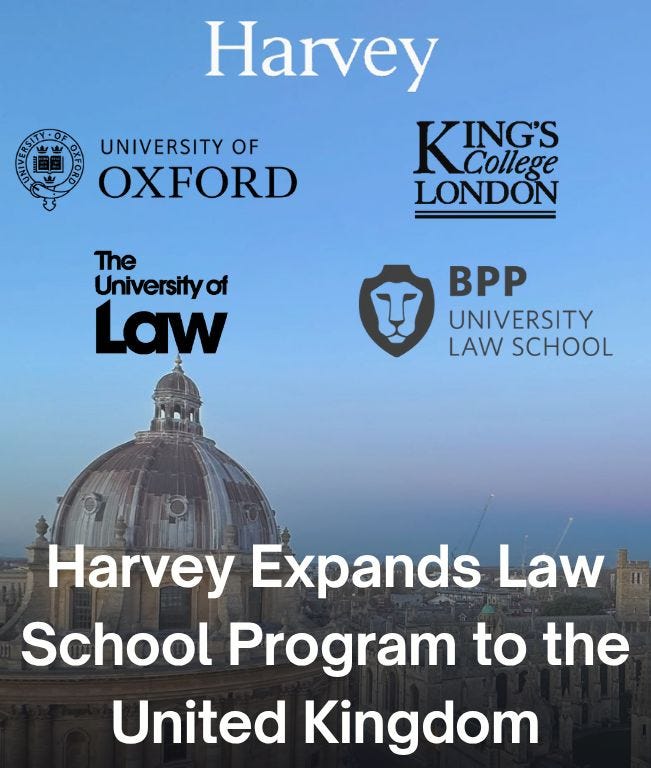
Harvey announced the international expansion of its Law School Program to the United Kingdom, partnering with Oxford University Faculty of Law, The University of Law, The Dickson Poon School of Law at King’s College London, and BPP University Law School. The program, launched in September, has already seen rapid adoption across over 25 leading U.S. schools including Stanford, University of Chicago, and the University of Pennsylvania.
King’s College London announced what it calls the world’s first AI Literacy Programme, launching in January. The programme gives every law student and staff member free access to four major legal AI tools - Harvey, Luminance, Legora and Lucio - backed by a customised 12-week online course and weekly practitioner workshops.
Each institution will use Harvey’s platform to meet its own unique needs. Oxford will focus on research initiatives, examining AI’s value in legal scholarship. BPP will include Harvey in training programs for aspiring solicitors and barristers.
George’s take: As a solicitor apprentice studying at BPP, this is amazing to see. Harvey has partnered with BPP and ULaw - institutions that train the majority of solicitor apprentices in the UK.
AI has already made knowledge work more equal. Many of my peers are already using these tools daily, but now that there is an official partnership that helps shape the curriculum. That really matters.
Most of us already work at - or will move to - City law firms that have deployed Harvey or Legora. Understanding how to use these tools effectively, and critically, understanding their limitations, is now essential to our professional development.
CLIFFORD CHANCE & PWC
2. Job Cuts Signal AI’s Impact on Entry-Level Roles

Clifford Chance confirmed it will cut business services roles in London, with up to 50 jobs potentially affected - that’s around 10% of its back office staff in the city.
The Financial Times reported that the Magic Circle firm told staff last month that greater use of AI and reduced demand for some business services meant that it needed to cut jobs. The firm is also said to have highlighted the growing volume of work carried out in its business support hubs in Poland and India.
Meanwhile, PwC’s global chairman Mohamed Kande told the BBC that AI may eventually lead to fewer entry-level graduates being hired. In 2021, PwC said it wanted to hire 100,000 people over five years, but Mr Kande said this would no longer be possible. “When we made the plans to hire that many people, the world looked very, very different. Now we have artificial intelligence. We want to hire, but I don’t know if it’s going to be the same level of people that we hire - it will be a different set of people”.
Every year, PwC hires thousands of new graduates in entry-level positions - including 1,300 in the UK and 3,200 in the US last year. An internal PwC presentation shows it will hire nearly one-third fewer entry-level associates in the US by 2028, with tax and assurance associate hiring projected to fall by 32 percent.
George’s take: You’re probably reading this are probably thinking: “Great, AI is going to take our jobs.” Not quite. These cuts are also driven by cost-saving measures, offshoring to lower-cost hubs, and reduced demand for certain services.
AI is great at general legal work. It’s far less effective at niche specialisations where context and nuance matter. If you become the go-to person for a specific industry or practice area, you’re significantly harder to replace.
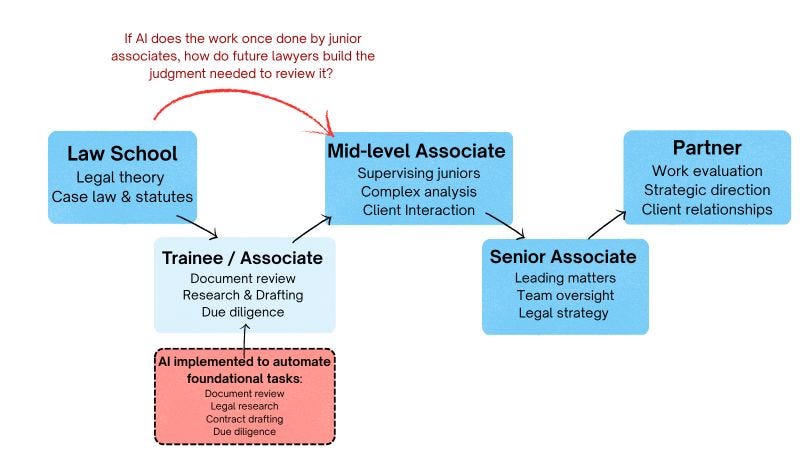
What’s more interesting is Kande’s point about hiring different people. Candidates must bring digital, analytical, and industry skills previously expected at mid-level roles.
NORM AI
3. Norm AI Launches AI-Native Law Firm With $50M Blackstone Investment
Norm AI announced an expansion of their relationship with Blackstone, the world’s largest alternative asset manager, as Norm accelerates its growth across legal and compliance AI and launches Norm Law LLP. Blackstone, through Blackstone Innovations Investments and funds affiliated with Blackstone Growth, has invested an additional $50 million in Norm Ai.
Norm Law will offer AI-native legal services, with an initial focus on financial services clients. Blackstone and Norm Ai are now collaborating to shape and develop Norm Law legal services for Blackstone’s use.
Norm Ai’s proprietary Legal Engineering approach combines their no-code AI platform with a quickly growing team of more than 35 top lawyers trained as Legal Engineers to convert legal workflows into Large Language Model-driven AI agents. The company’s client base collectively manages more than $30 trillion in assets, backed by Blackstone, Bain Capital, Vanguard, Citi, New York Life, TIAA, Coatue, and others. Norm Ai has raised more than $140 million.
John Nay, Norm’s founder and CEO, said: “To truly transform the delivery of legal services, lawyers and AI need to be fully integrated from the ground-up and from day-one. Norm Law is uniquely positioned at the intersection of AI and trusted expert attorneys”.
George’s take: Blackstone seem to be in a pretty interesting position here.
They’re simultaneously the biggest client, the biggest investor, and the partner co-developing the service offering. They’ve essentially piloted the technology internally, validated it works, and now they’re scaling it as an external service.
In other AI news: Google Launches Nano Banana Pro

Google just released Nano Banana Pro, its latest image generation model built on Gemini 3 Pro. The company claims Nano Banana Pro improves on its predecessor with the ability to create more detailed images and accurate text, and generate text in different styles, fonts, and languages.
The model has web-searching capabilities, so you can do things like ask it to look up a recipe and generate flash cards. Google says Nano Banana Pro is geared toward giving professionals more control over images, letting users control aspects like camera angles, scene lighting, depth of field, focus, and color grading. Compared to Nano Banana’s resolution cap of 1024 x 1024px, users can generate 2K or 4K images with Nano Banana Pro.
The Gemini app currently has over 650 million monthly active users, and Gemini-powered AI Overviews has 2 billion monthly users.
George’s take: The legal profession should pay attention to Google’s aggressive push into professional-grade AI tooling. Nano Banana Pro is rolling out to Google Workspace customers in Google Slides, Vids, the Gemini app, and NotebookLM. “Help me visualize” in Slides now uses Nano Banana Pro to help anyone create stunning infographics, images, and slides.
That’s everything for this week.
If you enjoyed reading this week’s roundup, consider sharing it with a friend.
I’m always looking for how to improve Best Practice. If you have any feedback, good or bad, hit reply to this email and let me know.
See you next week,
George
PS. Lawyers are loosing their training ground to AI. Join the conversation here.
This piece really made me think about the future of work and education. I particularly appreciated the mention of King's College London's AI Literacy Program. It's such a forward-thinking approach to ensure students are equiped, not just replaced. Education is truly key to navigating these big shifts.