

Meet The AI-First Law Firm Charging $100 For What Big Law Bills $5,000
Plus: Harvey's $160M raise at $8B, and what three years of ChatGPT has actually changed in Big Law

Sunday 7th December 2025. Newsletter #12
Hey, happy Sunday
This week, Harvey closed a $160 million Series F at an $8 billion valuation and launched client-facing collaboration tools. A former Cooley lawyer raised $2.5M to build an AI-native firm targeting founders who can’t afford traditional rates. And ChatGPT turned three years old - a good moment to assess what’s actually changed in Big Law beyond the marketing theatre.
Let’s dig in.
Partner with Best Practice - get your brand in front of 1,000+ legal professionals. Email george@georgehannah.com
HARVEY AI
1. Harvey Raises $160M and Launches Client-Facing Collaboration
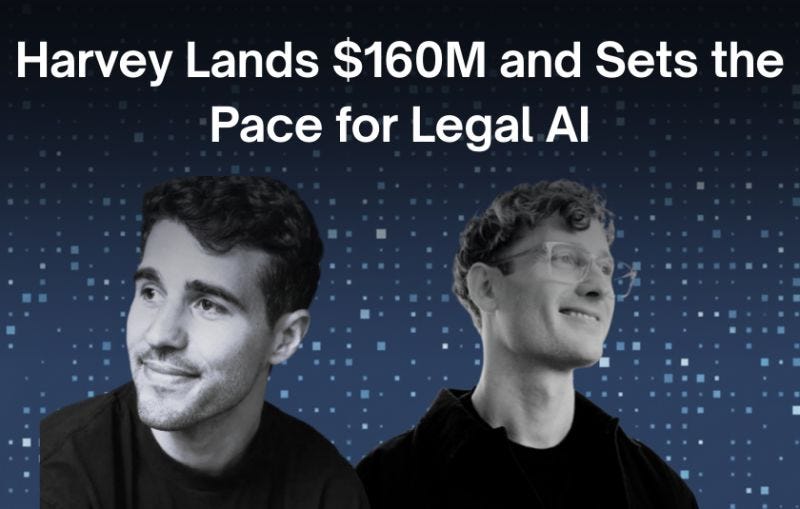
Fresh off a $160 million raise at an $8 billion valuation, Harvey launched “Shared Spaces” - an AI-powered hub for lawyers and clients to collaborate on documents and share firm expertise. The Andreessen Horowitz-led Series F comes just months after Harvey’s $300 million round in June and a €50 million investment from EQT in October.
This marks Harvey’s third major funding round in six months, signaling sustained investor appetite for legal AI infrastructure despite broader market uncertainty.
What Shared Spaces actually does:
The platform lets firms create secure workspaces where clients can collaborate on documents and “self-serve answers drawn directly from the firm’s knowledge and expertise.” Clients can spin up guest accounts without needing their own Harvey subscription, effectively allowing firms to package and distribute their institutional knowledge as a service.
Harvey is also running its first tender offer - a public proposal to buy shares from existing shareholders at a premium price - suggesting confidence in near-term liquidity events.
George’s take:
This announcement came just weeks after Legora launched their own “Portal” for client collaboration in November.
Once a client’s workflows depend on your AI platform, switching costs become much harder - you’re not just selling to the law firm anymore, you’re embedding into the client relationship itself.
Could Harvey or Legora eventually roll out native DMS functionality? Their workflows already revolve around creating and storing documents. Why not close the loop entirely?
SOXTON AI
2. Former Cooley Lawyer Raises $2.5M to Build AI-First Law Firm
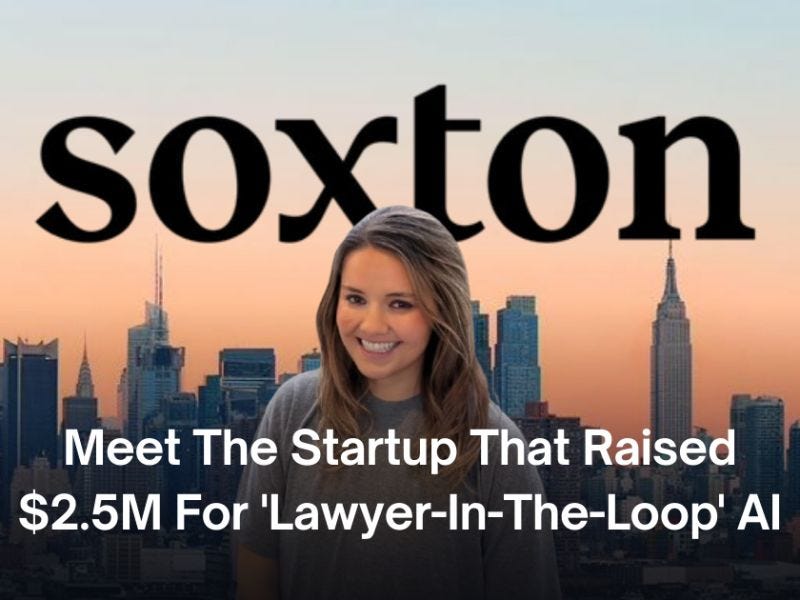
Soxton AI raised $2.5 million to build what they’re calling the first AI-first law firm, targeting early-stage founders who can’t afford traditional legal fees and would otherwise turn to ChatGPT for legal advice.
The firm has already served 270+ companies in stealth mode - mostly pre-seed startups navigating incorporation, contracts, and compliance without the budget for Big Law rates.
Founded by Logan Brown, a former Cooley lawyer, Soxton combines AI automation with human oversight. Their flagship service: bespoke contract drafting with four-hour turnaround for $100. “We deliver outcomes so founders don’t have to self-serve,” Brown explains. “They can trust a human has reviewed the doc.”
George’s take: Soxton isn’t competing with established firms - they’re expanding the market by capturing clients who would otherwise go unserved or rely on risky DIY solutions (eg using raw ChatGPT).
Think about the actual gap they’re filling:
Founders need legal help but can’t afford $500-$800/hour traditional rates
Generic AI tools like ChatGPT hallucinate case law and misstate critical details
Templates and self-service tools require legal knowledge to use correctly
Soxton sits in the middle: AI-powered efficiency with human verification, predictable pricing, and fast turnaround.
Plus, I think rather than viewing these startups as permanent clients, Soxton is building a pipeline. As these companies grow and raise Series A or B funding, many will graduate to full-service firms for complex litigation, M&A, or regulatory work. Soxton becomes the farm system for Big Law’s future client base.
CHATGPT ANNIVERSARY
3. ChatGPT Turns Three - What’s Actually Changed in Big Law?
ChatGPT launched three years ago this week when it dropped in November 2022.
Here’s what three years of ChatGPT has actually changed in Big Law:
1. Legal tech explosion
ChatGPT spawned countless legal-specific startups. Some pursue one-size-fits-all chatbot approaches. Others solve hyper-niche problems - billing optimisation, email management, contract analytics. The ecosystem has exploded with specialised solutions.
Funding has gone stratospheric. Companies like Harvey and Legora are raising rounds that would have seemed impossible three years ago. Total legal AI funding in 2025 likely exceeds $1 billion.
2. Marketing gold rush
Law firms have enthusiastically embraced the AI narrative. Chief AI Officers, vendor partnerships, innovation labs - the infrastructure of change is being built rapidly. The PR machine is in overdrive.
George’s take:
We still have too much chatbot theatre and not enough workflow integration. Firms announce AI partnerships in press releases but struggle with adoption internally. Lawyers need proper training to realise AI’s potential, not just surface-level demos from vendors.
The real transformation isn’t about buying tools - it’s about rethinking workflows, retraining staff, reconsidering pricing models, and fundamentally reimagining what it means to deliver legal services.
In other AI news: Alibaba Launches AI Glasses to Challenge Meta

Alibaba launched its Quark AI Glasses last week, marking the Chinese tech giant’s first foray into consumer hardware. The glasses come in two variants - the flagship S1 model starting at ¥3,799 ($537) with dual micro-OLED displays, and the more affordable G1 at ¥1,899 ($268) designed for everyday wear.
Currently available only in China across major e-commerce platforms and 604 optical stores in 82 cities, Alibaba plans international expansion in 2026. The smart glasses market is expected to double by 2026, with shipments exceeding 10 million units as major tech companies bet that wearables could become the next computing platform after smartphones.
George’s take: This is Amazon’s delivery glasses strategy applied to white-collar work - and it has direct implications for how lawyers will work in the near future.
Remember Amazon’s AI glasses from Newsletter #7? They shaved seconds off each delivery by putting navigation directly in drivers’ line of sight. Alibaba is applying the same principle to knowledge work: eliminate the friction of pulling out your phone or opening your laptop.
That’s everything for this week.
If you enjoyed reading this week’s roundup, consider sharing it with a friend.
I’m always looking for how to improve Best Practice. If you have any feedback, good or bad, hit reply to this email and let me know.
See you next week,
George