Microsoft Brings the Fight Inside Word
Plus: Slaughters goes with Harvey; Legora hits $5.6B with NVIDIA backing; LexisNexis moves on Doctrine

Hey, happy Sunday.
Another big week this week.
Slaughter and May picked Harvey. Legora added another $50 million to its Series D, with NVIDIA's venture arm joining the cap table. LexisNexis's parent moved on Doctrine. And Microsoft has now embedded a legal agent directly inside Word — built, in part, by engineers from a Robin AI (remember them?)
Want to get your brand seen by thousands of lawyers in the Best Practice Newsletter? Get in touch here.
THIS WEEK IN LEGAL AI
Microsoft Brings the Fight Inside Word
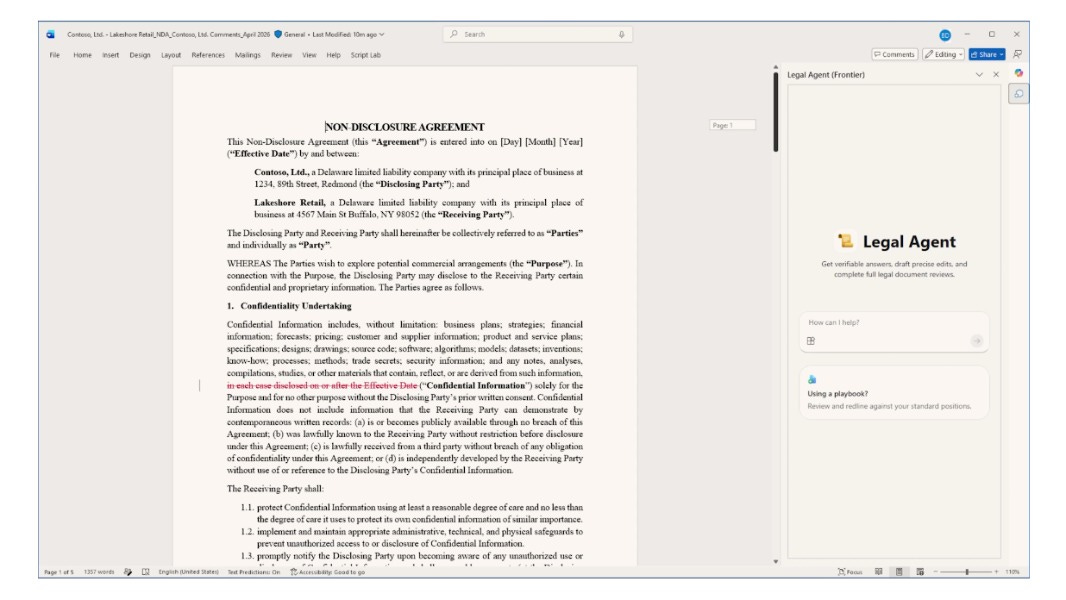
Microsoft introduced a Legal Agent embedded directly inside Word, available through its Frontier early-access programme in the US. On the surface, this looks like another entrant in an already crowded market. Look more closely, and it is arguably a very strategically significant move of the year, maybe more so than Anthropic’s Claude for Word plugin released earlier this year.
This is because Microsoft’s Legal Agent is not a third-party application sitting on top of Word. It is a first-party tool, built into the host environment by the company that owns it. According to Sumit Chauhan, President of Microsoft’s Office Product Group, the agent uses a “purpose-built insertion algorithm” and a “deterministic resolution layer” to apply edits, meaning it does not rely on an LLM to generate every revision.
The redlining engine understands Word’s underlying document structure rather than just visible text, preserving formatting, tables, lists and tracked changes. That tackles head-on one of the most persistent complaints lawyers have about generic AI in document workflows — which is the loss of fidelity when AI touches a heavily formatted contract.
Microsoft has been explicit that the agent was built “in close collaboration with legal engineers”. Multiple outlets have reported that engineers from Robin AI — the legal AI startup that wound down — were central to the build. Robin’s collapse was widely read at the time as a sign that early-stage legal AI companies were being squeezed out by larger, better-funded incumbents. But at least the talent did not vanish. Here it has been absorbed by the company best positioned to leverage it.
Why it matters
Microsoft already sit on the world’s most ubiquitous document editor, have an existing enterprise relationship with virtually every law firm and corporate legal department on the planet, and now has a credible, domain-specific product baked into that environment.
I do not think this kills the specialist platforms. The high end of the market — Magic Circle, US BigLaw, sophisticated corporates — will continue to want bespoke, deeply-integrated tools with serious customisation and dedicated customer transformation support.
Harvey, Legora and the others have built genuine moats with that work. But the long tail of mid-market firms, whose buying calculus is different, is exactly where a “good-enough” first-party Microsoft agent could quietly absorb a meaningful chunk of demand. Combined with Anthropic’s growing direct-to-lawyer ambitions, this is the clearest signal yet that the platform layer of legal AI is becoming contested ground.
THE BEST PRACTICE PODCAST
Gregory Mostyn - one of the most focused founders I’ve met to date.
We discussed:
→ Why Wexler went deep on litigation when every other legal AI startup was going broad
→ The “verification tax” and where fully agentic legal AI actually breaks down
→ Why consumption pricing beats per-seat for litigation work (and how they structure it)
→ How his 67-year-old father is now vibe-coding apps for his tennis club
→ What it takes to close a Big Law deal in a week
I absolutely loved recording this episode and I hope you enjoy listening to it just as much as I did.
Know someone that might want to come on the Best Practice Podcast? Email me at george@georgehannah.com
WORTH KNOWING
LexisNexis owner moves on Doctrine. RELX Group, the publicly listed parent of LexisNexis, announced on 28 April that it has entered into a put option agreement to acquire Doctrine, the Paris-based legal AI platform used daily by 27,000 legal professionals across France, Italy, Germany and Spain. Founded in 2016, Doctrine combines case law and regulatory content for civil law jurisdictions with AI-powered research and drafting tools. Terms have not been disclosed and completion is contingent on French employee consultation. This deal will help to bolster LexisNexis’s continental footprint.
OneAdvanced’s Legal Trends Report 2026. OneAdvanced’s tenth annual report, published this week, found that four out of five UK lawyers are currently using or planning to use generative AI, and that nearly half of surveyed firms believe they are ahead of their competitors on AI adoption.

Soren launches “private AI” for regulated industries, such as Legal. Y Combinator-backed Soren has emerged with a pitch that names lawyers and banks as primary targets. The model is to deploy and fine-tune AI inside the client’s own infrastructure rather than have data leave the perimeter. Co-founder Kevin Xie (pictured) describes the approach as building targeted automations that integrate with existing systems while keeping data scoped, logged and auditable end-to-end.

Farringdon launches as AI-native conveyancing firm. Backed by Orbital — the legal tech business behind around one in ten UK residential property transactions — Farringdon is regulated by the Council for Licensed Conveyancers and starts taking instructions in May. It is led by Orbital co-founder Ed Boulle. They run an interesting model; build and stress-test AI workflows inside the firm’s own caseload, then push the learnings back into the wider Orbital network. JLL and Streets Ahead are early agency partners.
FUNDING AND NEW PARTNERSHIPS
Legora, the Stockholm-based platform, has added a $50 million extension to its Series D, bringing the total round to $600 million and its post-money valuation to $5.6 billion. The headline names in the extension are NVIDIA’s venture arm, NVentures — its first investment in legal tech, according to Dealroom — and Atlassian. Legora has now raised $866 million since its 2023 founding, scaled from 40 to 400 employees in twelve months, and recently surpassed $100 million in ARR.
Slaughter and May adopts Harvey. The Magic Circle firm announced that it is rolling out Harvey across all practice areas to support its lawyers on multi-jurisdictional M&A, due diligence, regulatory research and document analysis. With Linklaters on Legora, A&O Shearman and now Slaughters on Harvey, and Freshfields working closely with Anthropic, four of the five Magic Circle firms have publicly aligned with a primary legal AI platform. Clifford Chance remains the holdout. Managing Partner David Johnson described lawyers as “the vital human layer that supervises AI” — a measured framing I suspect we will hear repeated.
Harvey hires Rachel Hepworth. Harvey has appointed Rachel Hepworth as Chief Marketing Officer. She was most recently CMO at Notion, before which she held senior marketing roles at Slack and was, more recently, advising AI companies including Lovable.
IN OTHER AI NEWS
Anthropic’s Project Deal

Anthropic published findings last week from an experiment it ran in its San Francisco office called Project Deal. The setup was to take 69 Anthropic employees, give each one $100 of gift card money to spend, and let an AI agent act as their representative in a one-week classifieds marketplace run entirely through Slack. Each agent could list items, make offers, counter-offer and close deals — without checking in with the human at any point. By the end of the week, the agents had completed 186 deals across more than 500 listings, totalling just over $4,000 in goods that included a snowboard, a wooden bowl, board games and a bag of ping-pong balls. Forty-six per cent of participants said afterwards they would pay for a service like this in the real world.
Anthropic ran four parallel marketplaces. In two of them, every agent used Claude Opus 4.5; in the other two, each participant had a fifty-fifty chance of being represented by Haiku 4.5, Anthropic’s smaller model. Participants did not know which agent they had. Opus agents closed about two more deals on average, sellers earned $2.68 more per item, and buyers saved $2.45. The interesting part is what did not happen: the people stuck with the weaker model did not notice. They rated the fairness of their deals just as highly as the Opus users did. Aggressive negotiating instructions, meanwhile, made no statistically significant difference at all. Model quality drove outcomes; prompting strategy did not.
The legal angle is more serious than it sounds: economists are now openly modelling worlds in which AI agents conduct most consumer transactions. What an interesting time to be alive!
Thanks, as always, for reading. More to come next week (including another podcast!)
If this was useful, share the love and pass it on to a colleague who would find it useful too!
George