

OpenAI's AgentKit Just Changed The Game For Legal AI
Plus more fresh funding and ChatGPT ends up in court.

Sunday, 12th October 2025. Newsletter #5
Good morning,
This week marked a turning point. OpenAI just handed every law firm the ability to build custom AI agents without writing code. Microsoft embedded AI directly into the tools lawyers already use daily. The funding floodgates opened with over $125 million pouring into Legal AI companies. And perhaps most telling: people are now using ChatGPT to win actual court cases. Let’s dig in.
Sponsored content: GrowHub

GrowHub has saved me countless hours over the past 10 months.
It transforms videos, podcasts, and articles into polished LinkedIn content in under 15 minutes, with no complex prompts needed.
Just paste your source, select a style, and you’re done.
Ideal if you’re building your personal brand but juggling a full schedule.
Try out a free trial here to see if it fits your workflow.
OPEN AI
1. OpenAI releases AgentKit
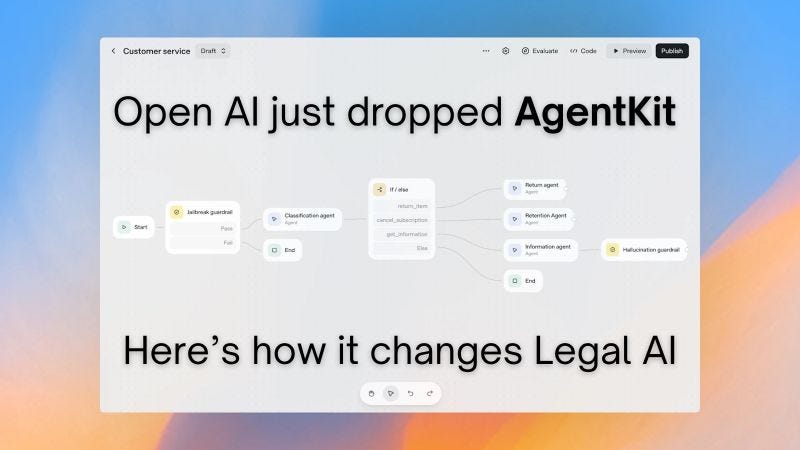
OpenAI launched AgentKit at DevDay on October 6th - a comprehensive toolkit that lets developers and enterprises build AI agents using drag-and-drop visual interfaces. No coding required.
The platform includes three core components:
Agent Builder: A visual canvas for creating multi-agent workflows with versioning and guardrails
Connector Registry: Centralised management for data connections across systems (Google Drive, SharePoint, Microsoft Teams, plus third-party tools)
ChatKit: Embeddable chat interfaces that integrate directly into existing products
In a live demo, an OpenAI engineer built two functioning agents in under eight minutes. Legal tech company Ramp reported building a procurement agent in “a few hours instead of months,” cutting iteration cycles by 70%.
George’s take: This is the moment Legal AI infrastructure goes from “enterprise project requiring six-figure budgets” to “something a tech-forward partner can deploy in a week.”
Until now, building useful legal AI meant either buying expensive platforms or hiring engineering talent to stitch together APIs. AgentKit eliminates both barriers. Any firm with a clear workflow map can now build custom agents that actually do legal work, not just assist with it.
The strategic question for established firms: Do you build on AgentKit internally, or wait for your vendors to do it for you? The firms that move first will have 12-18 months of pricing and efficiency advantage before this becomes table stakes.
The legal tech vendors should be nervous. OpenAI just handed their customers the toolkit to build competitive solutions in-house.
MICROSOFT
2. Microsoft Brings AI Agents to Excel and Word
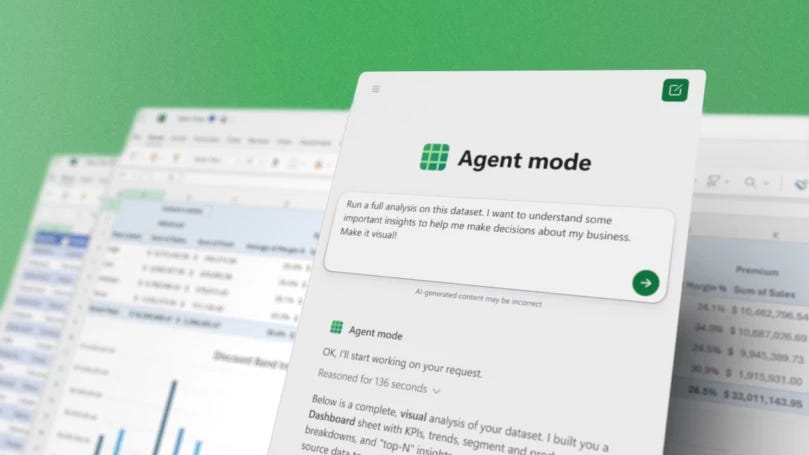
Microsoft launched “Agent Mode” for Excel and Word on September 29th, introducing what they’re calling “vibe working” - AI agents that perform multi-step tasks directly within the apps lawyers use most.
Agent Mode in Excel can build financial models, create loan calculators, generate P&L statements, and analyze datasets - all from natural language prompts. Tell it “analyze this discovery data and flag privilege issues,” and it selects formulas, creates visualizations, and validates results. In benchmarks, it scored 57.2% accuracy on SpreadsheetBench versus 20% for standard Copilot.
Agent Mode in Word drafts documents, updates reports using data from emails, and reformats content to match firm guidelines - all conversationally. No switching apps or copying/pasting.
George’s take: Legal has lagged behind other industries in AI adoption because lawyers are risk-averse and tool-averse. They don’t want to learn new platforms. They want their existing tools to work better. Microsoft just gave them exactly that.
But there’s a critical caveat that legal professionals need to understand: LLMs confidently state wrong answers. In casual use, that’s annoying. In Excel financial models or privilege logs, one hallucination could be catastrophically expensive.
Microsoft acknowledges this, warning that Agent Mode “should not be used for drawing conclusions in sensitive areas like financial, legal, or medical domains.” Yet they’re embedding it directly into those exact workflows. Law firms implementing this need verification protocols built into every use case; not as an afterthought, but as core infrastructure.
That said, the competitive implications are massive. Big Law’s technology advantage just narrowed significantly. Any firm with Office 365 (and their frontier package) now has access to AI-powered document analysis and data processing that would have cost six figures to implement last year.
I reckon within 24 months, Excel and Word-based AI workflows will be standard practice across the legal profession. The firms that master these native tools first - and build proper verification systems - will have a significant efficiency edge. The firms that don’t will face a junior-lawyer-sized gap in productivity.
SPELLBOOK AI, CROSBY, LUCIO AND HARVEY
3. Legal AI’s Funding Frenzy
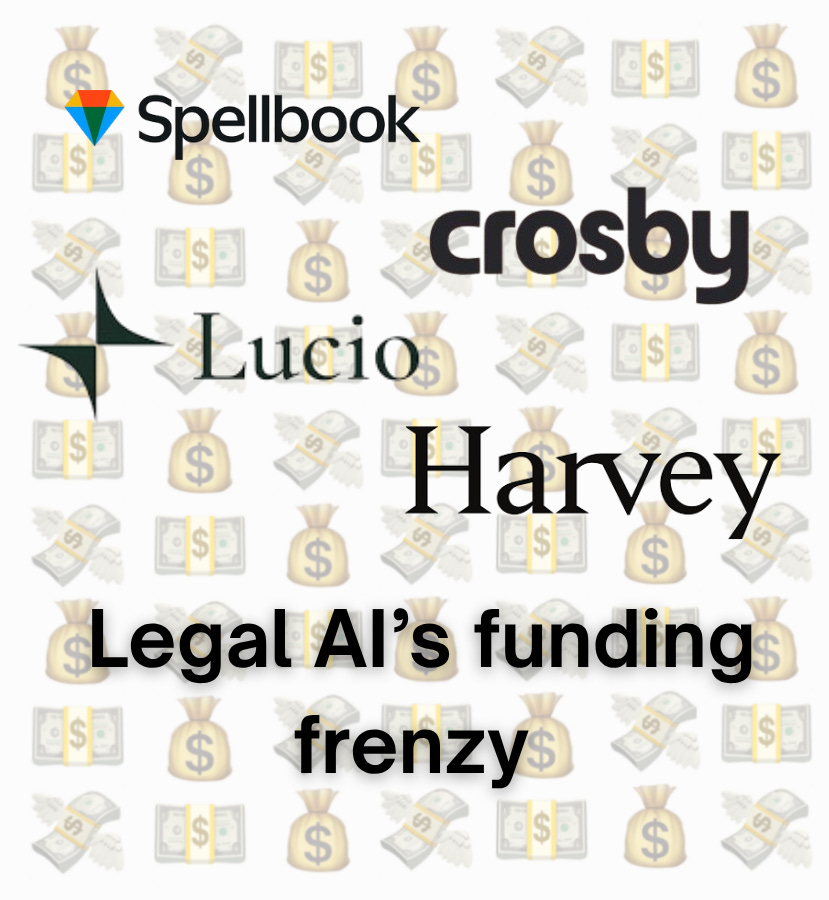
Legal AI companies closed over $125 million in funding in the past few weeks:
- Harvey: $50M from EQT, one of Europe’s largest private equity firms
- Spellbook: $50M round (previously announced but closed recently)
- Crosby: $20M raise including Palo Alto based firm Cooley investing.
- Lucio: $5M led by DeVC, announced October 7th. The India-based “AI-native legal workspace” now supports 3,000+ lawyers across 9 jurisdictions, claiming to save each lawyer 30 hours monthly.
George’s take: I wanted to focus in on Crosby’s raise here.
Co-founder Ryan Daniels (himself a former Cooley lawyer) put the speed gains in perspective: “It took us 173 days to review our first 1,000 contracts. Now, we do this every 3 weeks.”
This is Crosby’s second major raise in 2025. They secured $5.8 million in seed funding from Sequoia just four months ago.
Cooley are buying optionality. If Crosby succeeds in automating contract work, Cooley gets a return on investment. If Crosby fails, they learn what doesn’t work in AI-powered legal services. Either way, they win.
Plus, as an investor, Cooley now gets visibility into exactly how Crosby operates - their workflows, their AI capabilities, their client acquisition strategy. That’s priceless competitive intelligence.
Connect this to the broader funding picture: Harvey raised $50M, Spellbook raised $50M, Lucio raised $5M. Add Crosby’s $20M and you’ve got $125 million flowing into Legal AI this quarter.
OPEN AI
4. ChatGPT Is Winning Court Cases (And Judges Are Noticing)
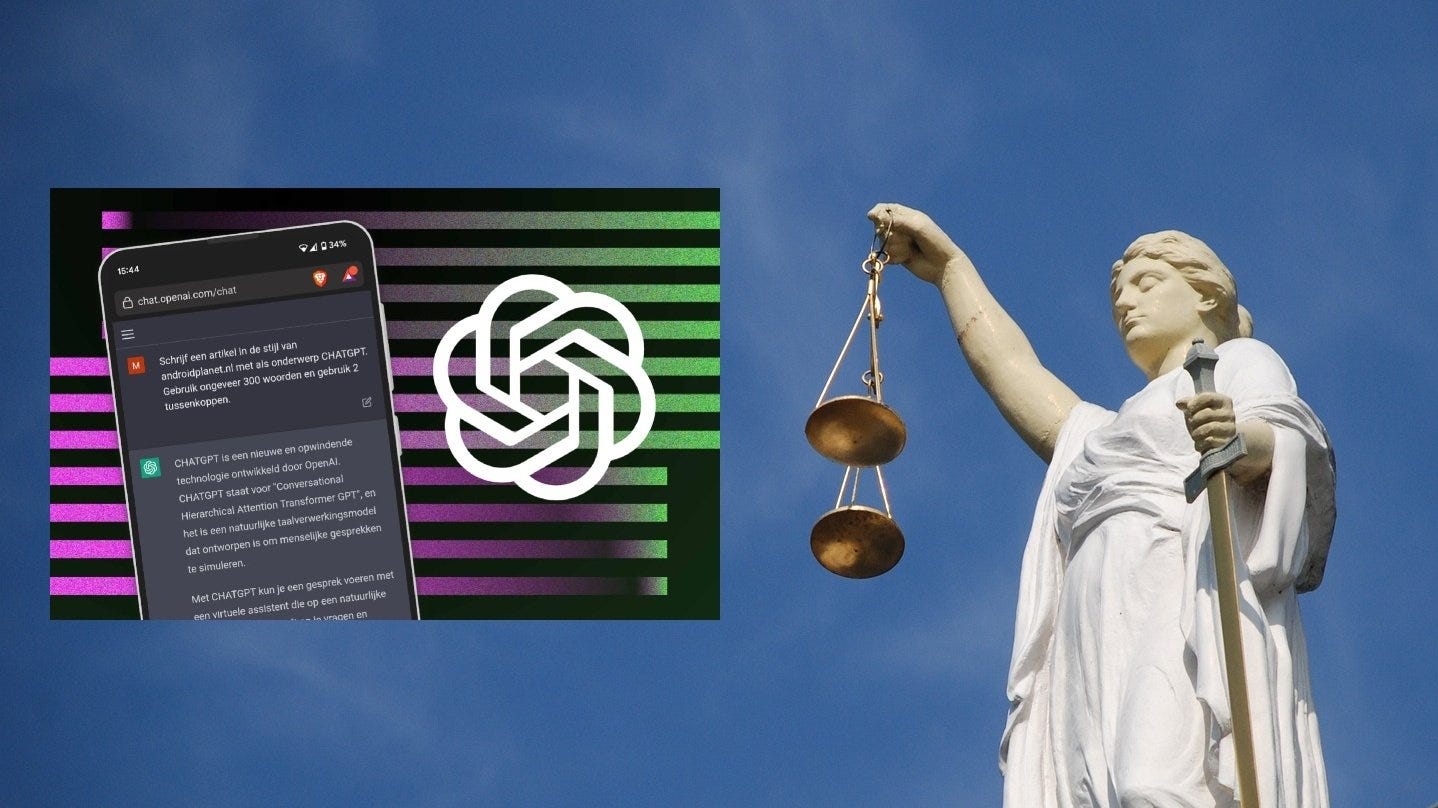
According to an NBC News investigation published on 8th October, pro se litigants (people representing themselves) are increasingly using ChatGPT to fight legal battles, and they’re starting to win.
A legal researcher has documented 282+ US cases where AI was used in court, with numbers accelerating sharply since spring 2025. The database only tracks cases where AI use was explicitly addressed by the court, suggesting the real number is far higher.
One notable case: Lynn White, facing eviction from her California trailer park, used ChatGPT and Perplexity AI to research rent deferral protections and successfully appeal her case. “It was like having God up there responding to my questions,” she said.
But it’s not all success stories. Courts have also documented failures - hallucinated case citations, ChatGPT-style formatting and emojis in legal documents, and filler language that wasn’t removed.
George’s take: This is the story that should terrify and excite the legal profession in equal measure.
We’re witnessing the democratisation of legal knowledge at a scale that would have been impossible five years ago. A tenant fighting eviction in California now has access to legal research capabilities that rival what a junior associate could provide. That’s remarkable.
The 282 documented cases are the tip of the iceberg. Most AI use in court isn’t flagged or disclosed because there’s no requirement to do so. The real number is likely 10x higher. And with ChatGPT hitting 800 million weekly active users, it’s only accelerating.
In other AI news: Rishi Sunak’s New Job

Former UK Prime Minister Rishi Sunak has joined both Anthropic and Microsoft as a senior AI advisor. The move places one of Britain’s most recent political leaders directly into the heart of the AI industry’s power structure, advising two of the most influential players in the space.
Sunak, who served as Prime Minister until July 2024, has been vocal about AI throughout his political career. During his tenure, he positioned the UK as a global AI safety hub, hosting the AI Safety Summit at Bletchley Park and establishing the UK’s AI Safety Institute.
George’s take: This is the move that law firms need to pay attention to, because it reveals where the real AI battleground is shifting.
For the past two years, the AI race has been about compute, data, and model performance. Who has the biggest training runs? Who can build the smartest models? That’s the race everyone’s been watching.
But Sunak’s appointment signals that the next phase of the AI race is about regulation and access. It doesn’t matter if you build the best AI model if governments ban it, restrict it, or regulate it into irrelevance. The companies that win will be the ones who shape the rules while others are scrambling to comply.
Connecting this to what’s happening in Legal AI specifically: We’re about to see a wave of regulation around AI in professional services. The EU AI Act already classifies certain legal applications as “high-risk.” The UK is developing its own framework. The US has a patchwork of state-level approaches.
large law firms building AI practices need to think like Anthropic and Microsoft, regulatory and policy expertise needs to be at the table from day one, not brought in after the fact.
That’s everything for this week.
If you enjoyed reading this weeks roundup, consider sharing it with a friend.
I’m always looking for how to improve Best Practice. If you have any feedback, good or bad, hit reply to this email and let me know.
See you next week,
George