

PwC Survey Reveals Legal AI's Widening Divide
Plus: PwC reveals the brutal economics of Legal AI adoption. Juro cuts out the legal tech middleman with direct ChatGPT integration. And 2 ex-Mishcon partners launch AI-first firm

Sunday, 26th October 2025. Newsletter #7
Good morning,
Best Practice has hit over 500 subscribers this week! I’m genuinely excited by how much this newsletter has grown in the past month and a half. Thank you for being part of this community.
This week: PwC’s survey reveals a brutal two-tier system in Legal AI adoption. Juro bypasses legal tech vendors entirely with direct ChatGPT integration. And two ex-Mishcon partners launch an AI-first law firm.
Let’s dig in.
Partner Content: GrowHub

GrowHub transforms videos, podcasts, and articles into polished LinkedIn content in under minutes, with no complex prompts needed.
Just paste your source, select a style, and you’re done.
Ideal if you’re a busy professional like me wanting to post timely content on Linkedin.
Try out a free trial here to see if it fits your workflow.
Want to get your brand in front of 500+ of legal professionals? Email george@georgehannah.com to find out more.
PWC LAW FIRM SURVEY
1. PwC Survey Reveals Legal AI’s Widening Divide
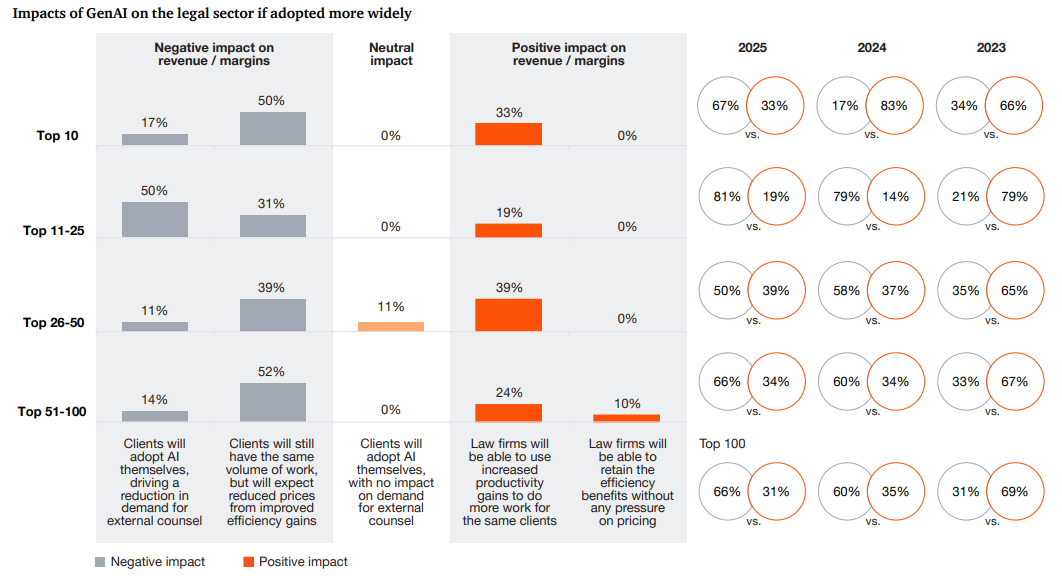
PwC’s latest law firm survey revealed where we are at with Legal AI, and how scale determines success. While 50% of Top 10 firms report productivity gains with monetisation, and 56% of Top 11-25 firms achieve similar outcomes, zero firms in the Top 51-100 bracket have monetised AI benefits yet.
Anticipated reductions in chargeable hours jumped from a weighted average of 11% in 2024 to 16% this year across Top 100 firms. Even more striking is that 67% of Top 10 firms now anticipate negative revenue or margin impacts (up from just 17% in 2024), driven primarily by client expectations for lower prices.
George’s take: This creates a fascinating prisoner’s dilemma. If you adopt AI, you become more efficient but clients expect price cuts. If you don’t adopt AI, you become uncompetitive against firms that can deliver faster, cheaper work. The only winning move is to deploy AI and fundamentally restructure your pricing model before competitors force your hand.
The next 18 months will be interesting, maybe we’ll see the first major law firm openly advertise “AI-enabled pricing” as a market differentiator. The firms that move first will set the new price ceiling. Everyone else will be forced to follow.
JURO
2. Juro Launches Direct ChatGPT Integration
Video credit: Juro
Contract management platform Juro launched direct ChatGPT integration via OpenAI’s Model Context Protocol this week, allowing customers to connect their contract workspaces directly to ChatGPT without using Juro’s interface. Users can now ask natural language questions about their contracts, find specific clauses, identify risks, and even draft new templates - all within ChatGPT itself.
Most platforms make API calls to OpenAI but force users to work within their proprietary chat interfaces. Juro is taking the opposite approach, meet lawyers where they already work. This is smart because according to Juro’s State of In-house Report 2025, more than 90% of in-house lawyers already use ChatGPT, Gemini, or Claude.
George’s take: For the past two years, every legal AI vendor has been racing to build their own “ChatGPT for lawyers” - custom interfaces, proprietary prompts, branded chat experiences.
I think the brilliance here is in the data moat, not the interface. Juro controls the contract data. ChatGPT provides the natural language layer. Users get ChatGPT’s latest features (Advanced Voice, Canvas, memory, improved reasoning) without waiting for Juro to catch up. Juro avoids the expensive AI product development cycle. Everyone wins.
I expect we’ll see similar integrations from other legal tech platforms within six months - maybe from NetDocs or iManage. The future of legal tech is becoming the pipes that connect lawyers’ existing AI tools to their firm’s data.
THREEPOINTS
3. Two Ex-Mishcon Partners Launch Threepoints

2 Former Mishcon de Reya partners Tom Murray and Simon Leaf have launched Threepoints, an AI-native law firm that integrates artificial intelligence into every aspect of service delivery from day one. The firm opened with more than a dozen founder clients spanning international tech suppliers, fast-growth media and real estate businesses, high-profile athletes, football clubs, and entrepreneurs.
The firm integrates Legora and Qanooni platforms from launch and partners with Excello Law’s House of Brands to outsource back-office functions including PAs, paralegals, finance, and compliance.
As co-founder Tom Murray explains: “As a new firm born in the AI era and unencumbered by legacy systems, we can deliver work faster, be more efficient and collaborate effectively in line with our clients’ needs.”
The firm also commits at least 5% of billing time and/or profits annually to charitable initiatives. Simon was recently listed on the Law Society’s inaugural Pro Bono Recognition List, and they’ve partnered with Bloomsbury Football Foundation as a Founding Charity Partner - an organisation that transforms over 5,000 young people’s lives weekly through football.
George’s take: What Threepoints demonstrates is how much more you can achieve with lean teams when AI is built into the foundation.
By integrating Legora and Qanooni from day one, a small team can deliver the same output that would traditionally require dozens of people. AI handles contract review, research, and document analysis. The platform manages administrative tasks. The lawyers focus on judgment, strategy, and client relationships.
It will be interesting to watch how well Threepoints pulls this off.
In other AI news: Amazon’s AI Delivery Glasses for Drivers
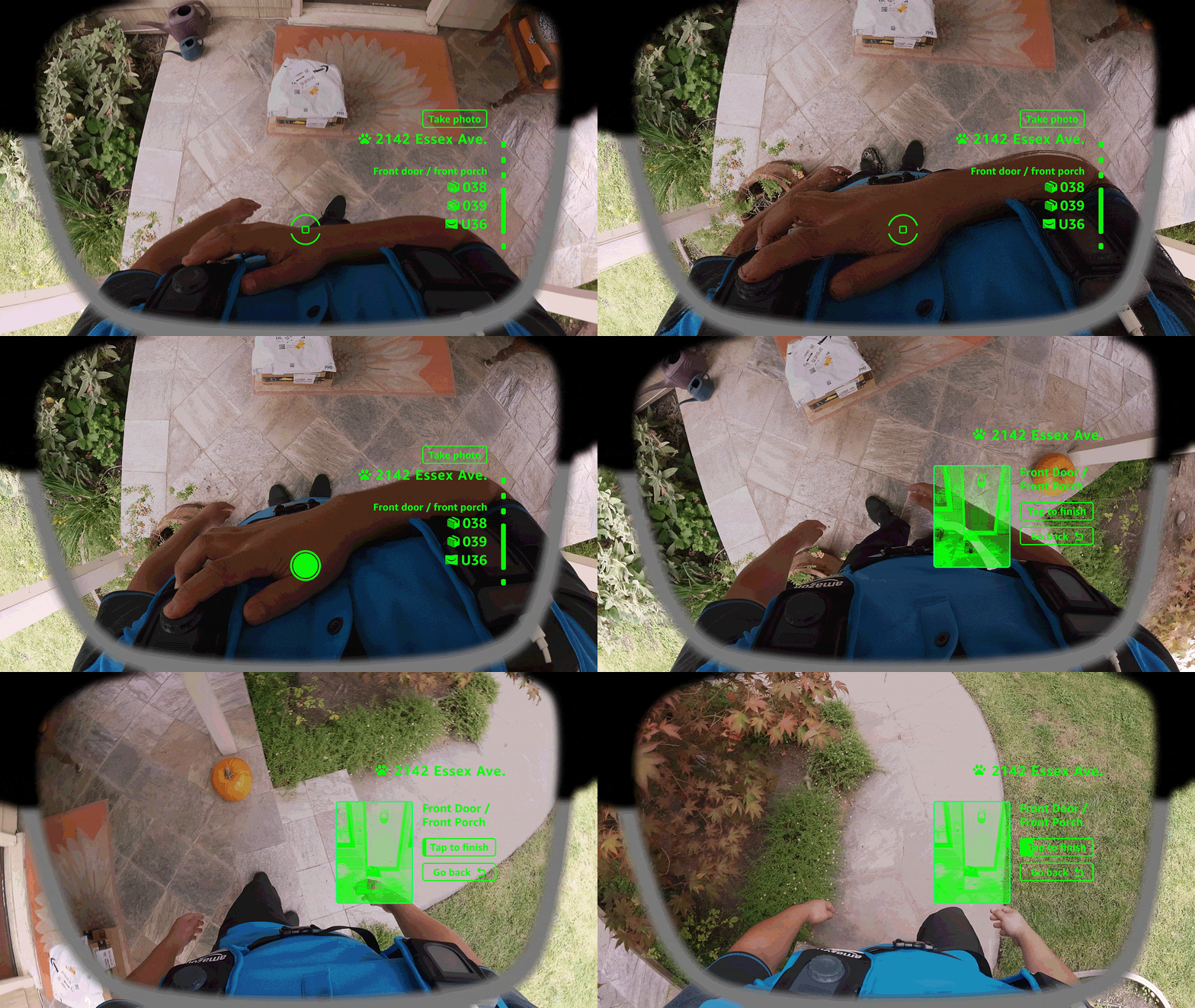
Amazon unveiled AI-powered delivery glasses for drivers this week, designed to provide turn-by-turn navigation while keeping drivers’ hands free. The glasses use embedded displays to guide drivers through delivery routes, identify package drop-off locations, and even navigate inside buildings.
The goal is to make drivers more efficient so they can complete more deliveries per shift. By freeing up drivers’ hands and providing real-time guidance directly in their line of sight, Amazon is shaving seconds off each stop. Those seconds compound across hundreds of stops per day and millions of deliveries globally.
What’s particularly interesting is how AI is being embedded into physical work tools rather than requiring workers to stop and consult a separate device. The glasses become part of the workflow itself, allowing drivers to work faster without adding cognitive load or extra steps.
Bonus: Takeaways from The Law Society Junior Lawyer Summit

I was fortunate to attend the Law Society Junior Lawyer Summit on Friday, where the conversation centred on “AI and the future of law” and the “lawyer of 2030.” Here are the standout takeaways:
Philip Young (Garfield AI): “This is the best time to be a lawyer. AI can now take the grudge work, so you can do more creative work. We’re seeing legal engineering jobs open up entirely new career paths.”
Catie Sheret (GC, Cambridge University Press & Assessment): “I’m in-house. We’re keeping more work in-house, using AI and tech to support us.” “The lawyer of 2030 will have O-shaped skills, be more comfortable using tech and AI, be less obsessed with billable hours, and have a better quality of life”
William Peake (Global MP, Harneys): “The best lawyers of 2030 will be those who are strong communicators who can explain complex concepts clearly”
The key is from Philip is “do not outsource your thinking”. Core legal skills remain essential - AI just changes how you apply them.
That’s everything for this week.
If you enjoyed reading this week’s roundup, consider sharing it with a friend.
I’m always looking for the latest on Legal AI. Send me a message if you’ve seen something I can cover, or just want to say hi!
See you next week,
George