

Simmons & Simmons AI internship, CILEX Joins AI Education and AI Tools Outperform Lawyers

Sunday, 21st September 2025
Good morning! It's been an exceptionally interesting week for Legal AI.
Here are the 3 top stories you need to know.
Simmons & Simmons LLP
1. Simmons & Simmons Launches UK's First AI Law Internship
S&S has unveiled what it calls the UK's first dedicated AI law internship, a two-week programme launching in April 2026.
The programme will place eight students in the firm's London AI team, working on "AI projects alongside Simmons' tech specialists, gaining experience in AI law, governance, enablement and transformation".
The timing is particularly significant. As Minesh Tanna, Simmons' global AI lead, said: "This is the only dedicated AI internship of its kind in the UK". By being first to market, Simmons is positioning itself to attract the brightest legal tech talent before competitors catch up. The firm's senior partner Julian Taylor, previously urged training contract hunters to focus on firms' AI capabilities rather than just salaries, arguing this "could define their future careers".
First reported by Non-Billable and Legal Cheek.
George’s take: This move will likely trigger a domino effect across Magic Circle and other top-tier firms. We're witnessing the emergence of AI law as a distinct career path, similar to how fintech or data privacy law evolved from general corporate practice into specialised fields. For law students, this signals that AI literacy isn't optional, instead it's becoming a prerequisite for career advancement.
CILEX, Harvey and Spellbook AI
2. CILEX Launches AI academy
This week, CILEX (The Chartered Institute of Legal Executives) announced its new AI Academy, developed in partnership with the AI-powered learning platform 5Mins.ai. The Academy aims to close the growing AI training gap within legal teams by delivering bite sized, personalised AI literacy training focused on generative AI, prompt engineering, AI ethics, data security, and professional responsibility. The platform even offers CILEX certification following successful completion.
CILEX’s commercial director Toby Moseley highlighted the urgent need for rapid AI upskilling to Lawcareers.net “Traditional training options aren’t always able to keep up with the pace of change... This new academy is designed to evolve to ensure that employees are trained on the most up-to-the-minute information... cultivating a culture where AI is understood across the organisation”.
This new initiative by CILEX complements existing moves by AI legal tech companies like Harvey AI and Spellbook, who have been actively giving free, early access to their platforms to law schools worldwide.
Georges take: Harvey and Spellbook’s strategy of embedding their tools into the education pipeline aims to make students proficient and comfortable with their AI platforms early in their careers. These students will undoubtedly influence future technology decisions in law firms and, eventually, become loyal users and clients of these AI solutions. CILEX AI academy will mean they are best placed to do exactly that.
3. AI Benchmarking Study Reveals Surprising Performance Gaps
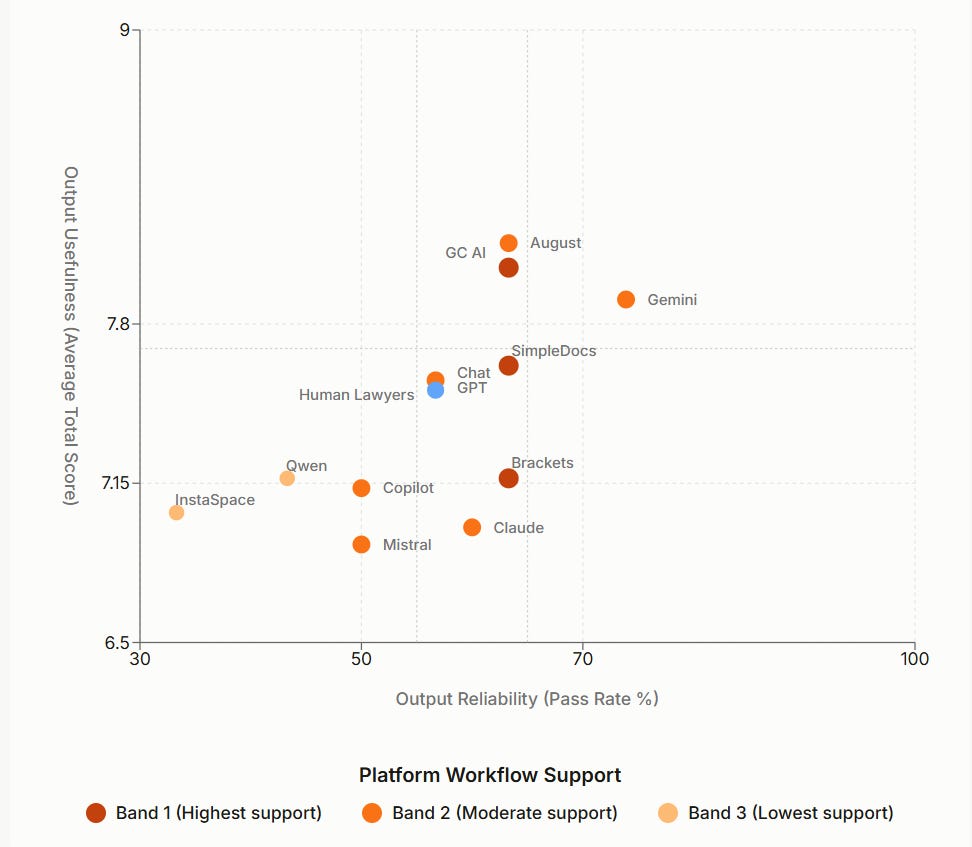
A comprehensive study by Legalbenchmarking.ai compared experienced lawyers against AI tools in contract drafting tasks, with results evaluated across usefulness, reliability, and platform support.
Key Findings:
Humans were reliable in 56.7% of tasks, while several AI tools met or exceeded this baseline
The best human lawyer produced reliable drafts 70% of the time, while the top AI tool achieved 73.3% reliability
AI tools identified material risks that lawyers missed entirely, with legal AI tools raising explicit risk warnings in 83% of outputs compared to 55% for general-purpose AI and none for humans
66.7% of solutions integrate with Microsoft Word, and most provide context handling that general-purpose AI tools lack
This study challenges two fundamental assumptions about AI in legal practice. First, that humans are inherently more reliable than AI in complex legal tasks. Second, that specialised legal AI tools significantly outperform general-purpose alternatives.
The most striking finding is the risk identification gap. Human lawyers raised zero explicit risk warnings in high-risk scenarios, while AI tools consistently flagged potential issues. This suggests AI may be more conservative and thorough in risk assessment. This is a crucial advantage in legal practice where missed risks can have severe consequences.
Note: Most legal tech vendors were included, but some withdrew their names or didn’t want to be included in the publishing.
George’s take: The study reveals that workflow integration matters more than raw performance. Legal AI tools don't necessarily produce better outputs than ChatGPT or Claude, but they integrate seamlessly into lawyers' existing Microsoft Word workflows and provide better context handling. This explains why specialised legal AI companies can compete despite not having the most advanced underlying models.
Wider AI World: OpenAI Study Reveals ChatGPT Usage Patterns
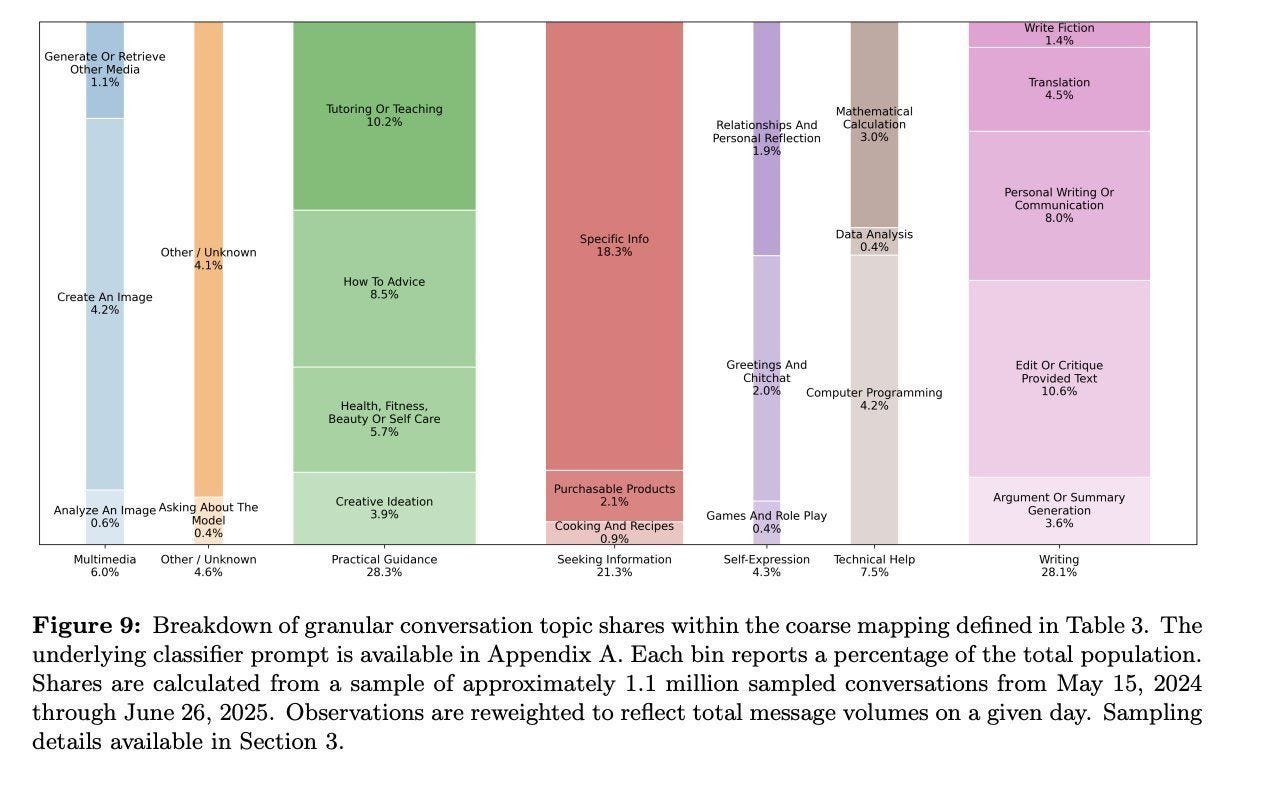
OpenAI published the first large-scale analysis of ChatGPT usage, analyzing 2.6 billion daily messages from 700 million users (nearly 10% of the world's adult population).
The study shows that weekly active users have surpassed 700 million in 2025, with message volumes soaring from 451 million per day in June 2024 to 2.6 billion a year later. However, engagement among long-term users has plateaued, with most growth now coming from new sign-ups rather than increased usage by existing users.
Here are the top use cases:
1/ tutoring + teaching (10.2%) - people want on-demand teachers more than almost anything else. A personal AI tutor that explains things your way, remembers your progress, and nudges you daily.
2/ how-to advice (8.5%) - “how to fix my CV,” “how to meal prep,” “how to set up my Shopify store.”
3/ personal writing + editing (18% combined) - 8% of traffic is people asking AI to write emails, 10.6% is editing or critiquing text. this is demand for AI copilots inside every workflow tool: sales, legal, HR, PR.
4/ health, fitness, beauty, self-care (5.7%) - validated consumer wedge. People already trust AI with their bodies. AI trainers, AI nutritionists, AI skin coaches.
5/ purchasable products (2.1%)- Tiny % but huge monetisation. People are literally asking AI what to buy. The Amazon affiliate model gets reborn here.
6/ translation (4.5%)still unsolved. What people want isn’t raw translation, it’s contextual translation: tone, culture, slang.
7/ computer programming (4.2%) - We know this, but it’s worth underlining: devs want copilots.
Georges take: ChatGPT isn’t replacing jobs, it’s replacing Google, coaches, and friends. The killer use cases aren’t coding or research, but tutoring, writing, self-care, and shopping advice. In other words, AI is becoming the first stop for life management.
That’s everything for this week.
If you enjoyed reading this weeks roundup, consider sharing it with a friend.
I’m always looking for how to improve Best Practice. If you have any feedback, good or bad, hit reply to this email and let me know.
See you next week,
George
Really loving this newsletter so far George - especially the sections on your takes!