

The Legal Plugin That Upended Legal Tech
Plus: Lawhive's $60M Round; Legora's Golf Deal and AI at the Olympics

Hey, happy Sunday.
What an absolutely extraordinary week for Legal AI. Anthropic dropped a legal plugin that sent shockwaves through the market, wiping billions off legal tech stocks. Meanwhile, Lawhive closed a massive $60M Series B less than a year after their Series A.
Let’s dig in.
1. Anthropic’s Extraordinary Week. But was it all an overreaction?
Anthropic has had a rather crazy week. First came the legal plugin announcement for Claude Cowork, which caused legal tech stocks tumbling.
The plugin automates contract review, NDA triage, compliance workflows, legal briefings, and templated responses. Users run /review-contract for clause-by-clause analysis against custom playbooks, or /triage-nda to categorize incoming agreements.
They then also released Claude Opus 4.6 on Thursday - the company’s most powerful model yet, featuring a 1-million-token context window, “agent teams” that can divide complex tasks across multiple AI agents working in parallel, and state-of-the-art performance on knowledge work benchmarks. The model outperforms OpenAI’s GPT-5.2 by 144 Elo points on economically valuable tasks in finance and legal domains, and achieved a 90.2% score on BigLaw Bench for legal reasoning.
Scott White, Anthropic’s head of product, describes the shift as moving toward “vibe working” - where AI handles end-to-end workflows in Excel, PowerPoint, and everyday business tasks without users needing technical expertise.
George’s take: So was the stock tumble all a bit of an overreaction? The legal plugins launch generated significant buzz, but it’s worth understanding what was actually released. It’s essentially a workflow template (a “Playbook”) that shows lawyers how to use Claude’s API for contract analysis ect. The innovation itself is in distribution and standardisation rather than technical capability.
One challenge for now is accessibility. These plugins run on Claude Cowork, which currently supports macOS, making rollout difficult in a profession dominated by Windows users (however, you can use Claude Code on Windows bit it takes more to setup). Additionally, data security concerns remain significant since information flows to Claude’s US servers and are’nt anonymised, making it unsuitable for confidential contracts.
Despite these limitations, the launch matters because it signals Anthropic’s shift from pure model development to the application layer. It also establishes templates that lawyers can customize and build upon, and validates market demand that will inevitably accelerate both product development and adoption as security solutions mature.
LAWHIVE
2. Lawhive Raises $60M Series B Less Than a Year After Series A
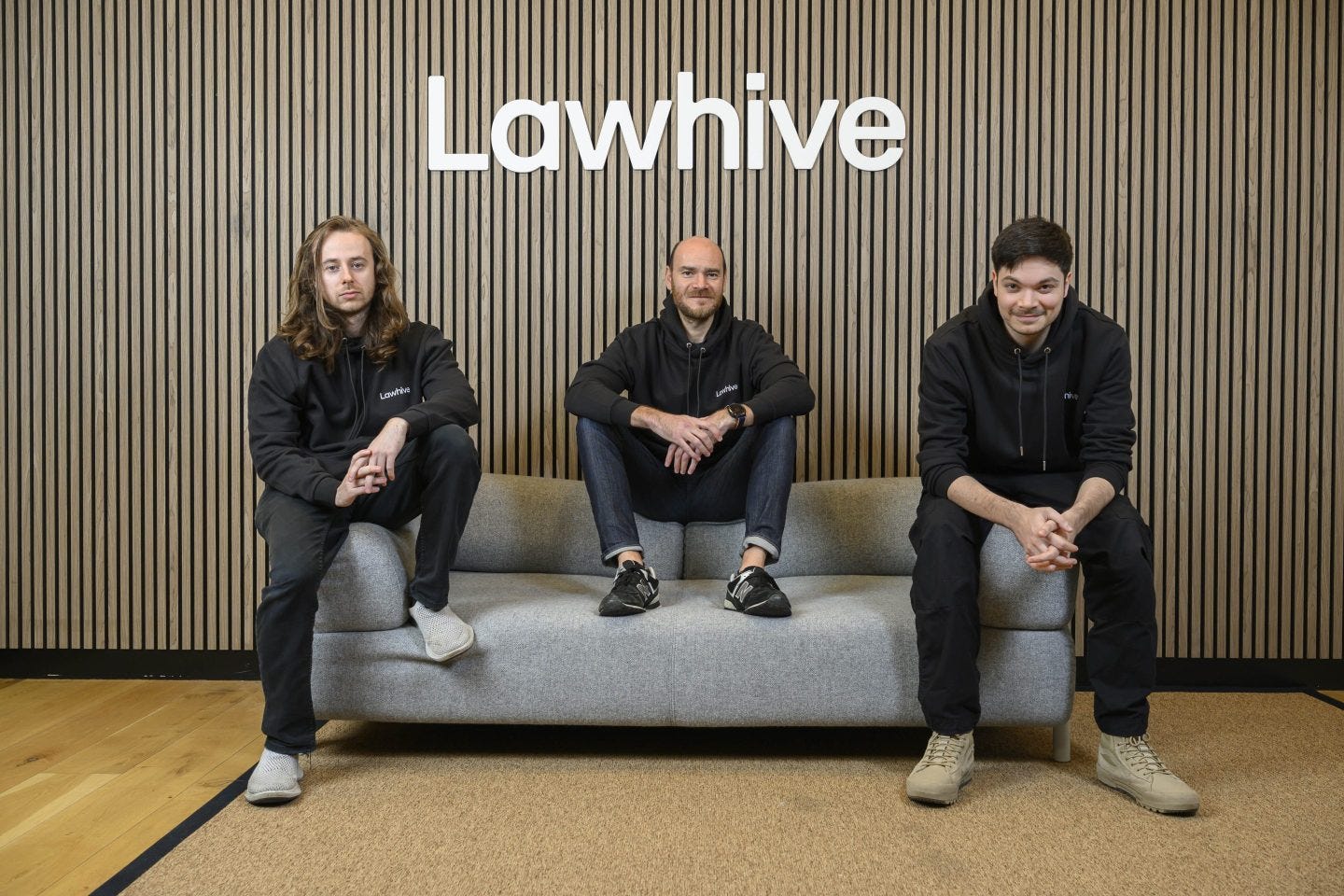
London-founded Lawhive closed a $60 million Series B this week, led by Mitch Rales (Danaher co-founder), with GV, TQ Ventures, Balderton Capital, and Jigsaw participating. That’s less than a year after their $40 million Series A.
Annual revenue surpassed $35 million after growing sevenfold in 12 months. The startup now operates in 35 US states with offices opening in Austin and New York.
They employ 450 lawyers supported by “Lawrence,” an AI-style paralegal that automates document drafting, research, and case management.
Lawhive started selling automation software to small firms but found them reluctant to buy. So they pivoted to become a law firm themselves, redesigning operations with AI handling much of the admin.
George's take: CEO Pierre Proner estimates there's a $200 billion consumer legal market in the US. By building an AI-native law firm rather than just selling software, Lawhive makes legal help genuinely more affordable and accessible while maintaining human lawyer oversight. Fixed pricing, fast turnaround times, and real solicitors checking AI-generated work is a glimpse of what we will be seeing more often in the future.
LEGORA
3. Legora Sponsors Swedish Golf Superstar Ludvig Åberg

In what might be a world-first, Legora announced a long-term sponsorship deal with Swedish professional golfer Ludvig Åberg this week.
Since turning professional in June 2023, the 26-year-old has rocketed to World No. 19, finishing runner-up at the 2024 Masters and winning twice on the European Ryder Cup team. He recently won the Genesis Invitational and set multiple PGA Tour scoring records.
Åberg commented: “You rely on data and insight, but in the end you’re responsible for the decisions you make. That’s what I respect about Legora - they enable speed and clarity without compromising judgment.”
George’s take: We have already seen AI companies accelerating into sports deals - Anthropic partnered with Williams F1, ElevenLabs with Audi F1, Meta AI with Mercedes-AMG.
But Legora is the first legal AI company to make this move. Sports sponsorship achieves three critical objectives for enterprise AI: brand legitimacy (associating with established sports signals credibility to cautious enterprise buyers), decision-maker access (C-suite executives who control six-figure AI budgets are the demographic watching professional golf), and category differentiation (a PGA sponsorship instantly distinguishes you from competitors still marketing through LinkedIn webinars).
More importantly, it signals they are becoming brand. A company that is more recognised in the AI space rather than just in legal tech.
In other AI news: Team USA Brings AI to the Ice

The 2026 Winter Olympics kicked off in Milan Cortina this week with Team USA deploying AI tools that compress months of aerodynamic testing into single-day turnarounds. The speedskating team’s Slippery Fish app creates digital avatars from uploaded images, simulating how posture changes affect drag on the ice without requiring expensive wind tunnel sessions. Meanwhile, the bobsled team partnered with Snowflake to process 100 data points per second from sled-mounted sensors, allowing coaches to optimise push sequences and loading positions between runs.
That’s everything for this week.
If you enjoyed reading this week’s roundup, consider sharing it with a friend.
I’m always looking for how to improve Best Practice. If you have any feedback, good or bad, hit reply to this email and let me know.
See you next week,
George